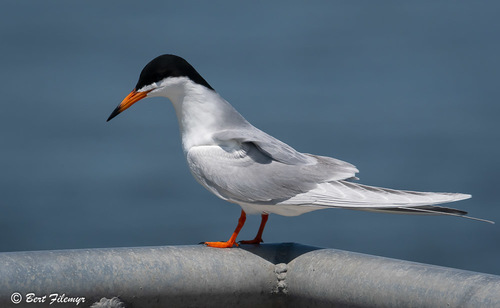
Forster's Tern
Sterna forsteri
A master of the marsh, the Forster's Tern is a sleek, acrobatic hunter known for its dramatic plunge-dives and distinctive winter 'eye-muffs.' Whether nesting in interior wetlands or wintering on coastal shores, this elegant bird is a favorite for backyard birders with an eye for water-loving species.
Quick Identification
Size
Length: 13–14 in (33–36 cm); Wingspan: 30–31 in (76–79 cm); Weight: 4.6–6.7 oz (130–190 g)
Colors
Breeding adults have pale gray upperparts, white underparts, a black cap, and an orange bill with a black tip. Non-breeding adults lose the cap, showing a white head with a distinctive black eye patch.
Key Features
- Deeply forked tail with long outer feathers
- Silvery-white primary wing feathers
- Distinctive black 'ear muff' eye patch in winter
- Bright orange-red legs and feet
When You’ll See Them
Geographic range
Where Does the Forster's Tern Live?
Native to North America, Forster’s Terns primarily breed across the interior of the northern United States and southern Canada, particularly in the prairie pothole regions and around the Great Lakes. During the winter months, they migrate to the coastal regions of the southern United States, Mexico, and Central America, where they frequent estuaries and bays. Their unique ability to adapt to both freshwater and saltwater environments allows them to thrive across a vast longitudinal range from the Atlantic to the Pacific coasts.
Basemap © OpenStreetMap contributors
Behavior
Forster's Terns are incredibly agile hunters, often seen hovering high above the water before tucking their wings and performing a dramatic plunge-dive to catch small fish. Unlike many other terns that prefer the open ocean, Forster's is a specialist of the marsh and shallow interior waters. They are highly social birds, often seen in small groups or mixed flocks with other gulls and terns, communicating with harsh, raspy 'zaar' calls that are easy to distinguish once you know what to listen for.
During the nesting season, they are colonial breeders, building nests on floating mats of vegetation or on the tops of muskrat houses. While they are generally wary of humans, they can be quite bold when defending their nesting sites, swooping at perceived intruders. In the winter, they transition to coastal areas but remain active foragers throughout the daylight hours, frequently resting on docks, pilings, or sandy beaches during high tide.
EverydayEarth exclusive
Camera Tips
To capture the Forster's Tern on a backyard or trail camera, placement is everything. Since these birds are rarely found far from water, you should position your camera along the edges of marshes, ponds, or slow-moving streams. For those with waterfront property, setting a camera on a tripod at a low angle near the water's edge can capture stunning shots of them landing or taking off. If you have a private dock, mounting a camera to a piling or the railing—angled toward a favorite perching spot—is a highly effective strategy, as they love to rest on man-made structures during high tide.
Unlike garden songbirds, Forster's Terns won't be attracted to traditional birdseed. Instead, try to set up your camera near areas where small fish, like minnows or silversides, are abundant. If you are using an AI-powered camera with a fast shutter speed, focus on areas with high-contrast light, as their white and light gray plumage can easily wash out in the midday sun. Early morning or late afternoon light provides the best 'golden hour' glow for their feathers and helps the AI distinguish the black cap or eye patches more clearly.
For settings, use a high-sensitivity motion trigger with a short burst mode (3-5 photos). These birds are fast; by the time a single photo is taken, they may have already flown out of the frame. If your camera allows for video, a 10-second clip is often better for capturing their unique hovering behavior. During the winter months, look for them on sandy beaches; placing a camera low to the ground using a sandbag can provide a dramatic perspective that highlights their sleek, aerodynamic profile against the horizon.
Similar Species
Species that look similar or are commonly confused with Forster's Tern.
Common Tern
Differentiated by its darker wingtips and the black nuchal band that wraps around the back of the head in winter.
Least Tern
Much smaller in size with a yellow bill and a white forehead patch during the breeding season.
Caspian Tern
Significantly larger with a much thicker, blood-red bill and a less deeply forked tail.
Frequently Asked Questions
Record Forster's Tern at your habitat
Connect a camera to start building your own species record — AI identifies every visitor automatically.