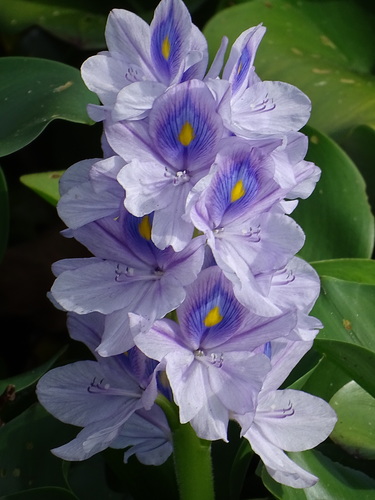
common water hyacinth
Pontederia crassipes
The common water hyacinth is a floating marvel known for its stunning lavender spikes and incredible speed. While it's a favorite for backyard pond enthusiasts, its ability to quickly take over a waterway makes it a fascinating subject for time-lapse photography.
Quick Identification
Size
Height up to 1 m (3.3 ft); leaves 10-20 cm (4-8 in) across; flower spikes 15-30 cm (6-12 in) long.
Colors
Glossy green leaves; lavender to light blue flowers; prominent yellow teardrop-shaped spot on the upper petal; dark purple to black feathery roots.
Key Features
- Thick, waxy, rounded green leaves
- Bulbous, air-filled stems (petioles) for buoyancy
- Showy six-petaled lavender flowers with a central yellow 'eye'
- Dense, trailing root system that hangs in the water
- Free-floating growth habit without being anchored to soil
When You’ll See Them
Geographic range
Where Does the common water hyacinth Live?
Originally native to the tropical Amazon Basin of South America, the common water hyacinth has expanded its reach to nearly every continent except Antarctica. It is now widely established across the southern United States, throughout Southeast Asia, tropical Africa, and parts of Australia. Because it thrives in warm, nutrient-rich waters, it is frequently found in regions where human runoff provides the fertilizers it needs to grow explosively.
Basemap © OpenStreetMap contributors
Behavior
The common water hyacinth is one of the fastest-growing plants in the world, renowned for its ability to double its population in just two weeks. It behaves as a free-floating colonizer, using its specialized bulbous stems as life jackets to drift across the surface of still or slow-moving freshwater. This movement allows it to quickly occupy any available open water, often forming dense, interwoven mats so thick that humans can sometimes walk across them (though it is not recommended!).
While it is celebrated for its beautiful orchid-like blooms, its behavior in the wild is often aggressive. These mats block sunlight from reaching submerged plants and prevent the exchange of oxygen at the water's surface, which can lead to the suffocation of fish populations. In backyard settings, it interacts with humans as a popular but high-maintenance ornamental plant that requires regular thinning to prevent it from overwhelming garden ponds.
EverydayEarth exclusive
Camera Tips
Capturing the common water hyacinth on a backyard camera requires a different approach than filming wildlife. Since the plant moves with the wind and current rather than its own volition, traditional motion triggers can be problematic. To avoid thousands of empty files, set your camera to a 'Time Lapse' mode. Capturing one frame every hour will allow you to create a stunning video showing the 'colonization' of your pond and the rapid opening of its flowers.
For the best visual results, mount your camera on a short stake or tripod at the edge of the water, angled slightly downward. A 'frog's eye view'—positioning the lens just a few inches above the water line—creates a more immersive and dramatic look at the bulbous stems and waxy leaves. If you are specifically looking to capture the flowers, ensure the lens is facing a south-easterly direction to catch the morning light without the harsh glare of the midday sun reflecting off the waxy leaves.
Lighting is the biggest challenge when filming aquatic plants. The waxy surface of the leaves can cause significant 'hot spots' or blown-out highlights in direct sunlight. If possible, place your camera in a spot that receives dappled sunlight or use a polarizing filter to cut down on water reflections. During the peak blooming season, check your camera's focus manually to ensure it is locked on the flower spikes rather than the water surface behind them.
Finally, use your camera as a management tool. By reviewing your footage weekly, you can calculate the 'percent cover' of the hyacinth in your pond. This is an excellent way to determine when it's time to harvest some of the plants to maintain a healthy ecosystem for your fish. If you notice the plants drifting toward one side of the pond consistently, it can also give you insights into the prevailing wind patterns of your backyard.
Similar Species
Species that look similar or are commonly confused with common water hyacinth.
Frequently Asked Questions
Record common water hyacinth at your habitat
Connect a camera to start building your own species record — AI identifies every visitor automatically.