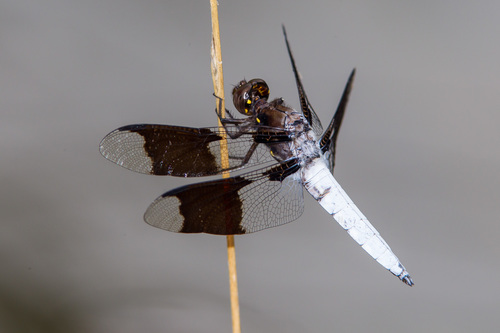
Common Whitetail
Plathemis lydia
A bold guardian of the garden pond, the Common Whitetail stands out with its striking chalk-white body and checkered wings. This expert aerialist is a master of the 'sit-and-wait' hunt, making it a perfect subject for backyard observers.
Quick Identification
Size
Length: 4.2–4.8 cm (1.7–1.9 in); Wingspan: 6–7.5 cm (2.4–3 in)
Colors
Males feature a distinctive chalky-white abdomen and wings with large brownish-black bands. Females are brown with three dark spots on each wing and white zigzag abdominal markings.
Key Features
- Chalky-white abdomen in mature males
- Large dark brown bands on translucent wings
- White zigzag stripes on the sides of the female's abdomen
- Wings held horizontally and slightly forward at rest
- Stocky, robust body shape
When You’ll See Them
Geographic range
Where Does the Common Whitetail Live?
Native to North America, the Common Whitetail is one of the most widespread dragonflies on the continent. Its range extends from coast to coast across the United States, reaching north into the southern provinces of Canada and south into northern Mexico. Because they are highly adaptable to man-made water features, they are just as likely to be found in a remote mountain wetland as they are in a busy suburban backyard.
Basemap © OpenStreetMap contributors
Behavior
Common Whitetails are highly territorial and bold dragonflies. Males are frequently seen patrolling a specific stretch of shoreline or garden space, vigorously chasing away other males. When they aren't flying, they prefer to perch on flat surfaces like rocks, logs, or even paved paths, which allow them to soak up the sun's heat. They are known for a unique display where they raise their white abdomens upward to signal territorial boundaries to rivals.
These dragonflies are exceptional aerial hunters. They utilize a 'sit-and-wait' strategy, perching on a prominent twig and darting out to snatch small flying insects from the air before returning to the same spot. Unlike many other dragonfly species that are shy around humans, Common Whitetails are relatively curious and may even hover near people to inspect them or hunt the small gnats disturbed by human movement.
EverydayEarth exclusive
Camera Tips
To capture high-quality images of the Common Whitetail, focus your camera on 'sentinel perches.' These dragonflies are creatures of habit and will return to the same sun-drenched twig, stone, or fence post dozens of times a day. Position your AI-powered camera about 2 to 4 feet away from a prominent, isolated branch near the water's edge. Ensure the camera is angled to capture the profile of the insect, as this highlights the male's white abdomen and the intricate wing patterns.
Lighting is the most critical factor for insect photography. Common Whitetails are most active in full, direct sunlight. To avoid harsh shadows or silhouetting, try to position your camera with the sun at its 'back,' illuminating the perch directly. If you are using a trail camera, look for one with a fast trigger speed (under 0.5 seconds), as these dragonflies land and take off with incredible speed. Using a 'burst mode' or short video clips is often more effective than single photos for catching that perfect wings-spread moment.
If you don't have a natural pond, you can lure them to a specific spot by placing a dry, grey branch or a flat, dark rock in the sunniest part of your yard. If there is a water source nearby, they will naturally seek out these elevated spots to survey their territory. Seasonal timing is also key; in most temperate regions, you will get the best results between June and August when the adult population is at its peak and males are most active in defending their territories.
Similar Species
Species that look similar or are commonly confused with Common Whitetail.
Frequently Asked Questions
Record Common Whitetail at your habitat
Connect a camera to start building your own species record — AI identifies every visitor automatically.