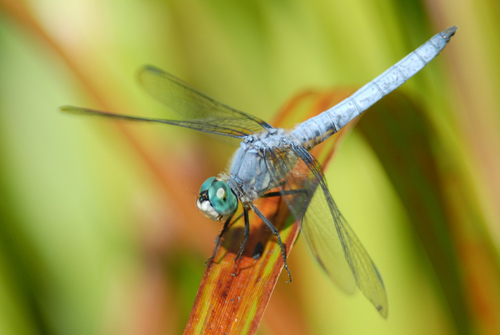
Blue Dasher
Pachydiplax longipennis
A master of aerial combat and the undisputed king of the backyard pond, the Blue Dasher is a stunning example of nature's precision engineering. Its metallic green eyes and powdery blue body make it a favorite for nature photographers and garden enthusiasts.
Quick Identification
Size
Length 25–45 mm (1.0–1.8 in); Wingspan 45–70 mm (1.8–2.8 in)
Colors
Males have a powdery blue abdomen with a black tip and metallic green eyes; females are brownish-black with yellow stripes and reddish-brown eyes.
Key Features
- Powdery blue abdomen with a distinct black tip (males)
- Metallic emerald-green eyes and a bright white face
- Two yellowish stripes on the side of the thorax
- Clear wings with small amber patches at the base of the hindwings
When You’ll See Them
Geographic range
Where Does the Blue Dasher Live?
Native to North America, the Blue Dasher is one of the most widely distributed dragonflies on the continent. Its core range spans the entire United States and southern Canada, extending south through Mexico and into the Caribbean islands, including the Bahamas. While it is a North American specialist, its high adaptability allows it to inhabit everything from pristine mountain lakes to urban drainage basins and suburban garden ponds.
Basemap © OpenStreetMap contributors
Behavior
The Blue Dasher is one of the most common and territorial skimmers in North America. Males are frequently seen perching on low vegetation or dry twigs near the water's edge, where they wait to intercept prey or chase off competing males. They are exceptionally agile flyers, capable of hovering, flying backwards, and making sudden, high-speed turns to snatch small insects from the air.
During the hottest parts of the day, Blue Dashers exhibit a fascinating thermoregulation behavior known as the obelisk posture. They raise their abdomen straight into the air, pointing it directly at the sun to minimize the surface area exposed to heat. While in this position, they remain perfectly still, alert for any movement on their territory. Females are generally more elusive, spending more time in tall grass and meadows away from the water until they are ready to mate and lay eggs.
EverydayEarth exclusive
Camera Tips
Capturing a Blue Dasher with an AI-powered camera requires understanding their perching habits. These dragonflies are creatures of habit and will often return to the exact same twig or reed dozens of times per hour. To get the best shot, place a dry stick or bamboo stake in your garden pond, extending about 12-18 inches above the water. Aim your camera at this 'perch' from a distance of about 3 to 5 feet, depending on your lens's minimum focus distance.
Because they are small and fast, a high shutter speed is your best friend. If your camera settings allow, aim for at least 1/1000s to freeze their wing motion. Since they are most active during the brightest part of the day, you will usually have enough light to use a lower ISO, ensuring the metallic details of their eyes and the waxy blue 'pruinescence' of the male's body are crisp and clear.
For the most professional-looking captures, pay attention to the background behind your perch. A distant, soft-colored background like water or a green lawn will create a beautiful bokeh effect that makes the dragonfly stand out. Avoid cluttered backgrounds like dense bushes, which can confuse AI detection and distract the viewer. If you are using a trail camera, ensure it has a macro or close-up focus capability, as standard trail cams often have a focus point too far away for small insects.
Similar Species
Species that look similar or are commonly confused with Blue Dasher.
Frequently Asked Questions
Record Blue Dasher at your habitat
Connect a camera to start building your own species record — AI identifies every visitor automatically.