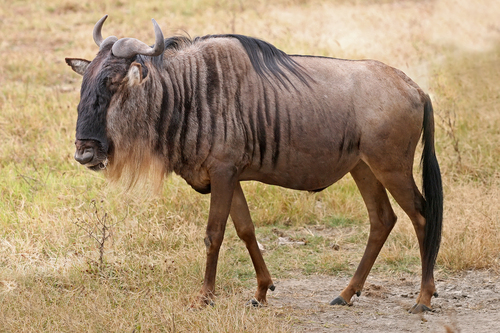
Common Wildebeest
Connochaetes taurinus
Witness the thunderous heart of the African savanna. The Common Wildebeest is a resilient nomad, famous for its epic migrations and its unique, front-heavy silhouette against the horizon.
Quick Identification
Size
1.7–2.4 m (5.6–7.9 ft) long; shoulder height 1.1–1.4 m (3.8–4.7 ft); weight 120–290 kg (265–640 lbs)
Colors
Slate-grey to bluish-grey body with dark vertical 'brindle' stripes; black mane, beard, and tail. Subspecies may have white beards.
Key Features
- Front-heavy, muscular build with a broad, boxy muzzle
- Large, smooth horns that curve outward and then inward toward the tips
- Long, horse-like black tail reaching nearly to the ground
- Distinctive dark vertical stripes along the neck and shoulders
When You’ll See Them
Sightings on EverydayEarth
Aug 2, 2026
A large African Elephant stands prominently in the center-left of the scene, occasionally flapping its ears. In the background, a herd of Blue Wildebeest is moving across the dry, dusty ground, kicking up a small cloud of dust as they travel. In the foreground, two Egyptian Geese are perched near the water's edge at the bottom right.
Aug 1, 2026
A bustling scene at the waterhole features several Waterbuck drinking at the edge. In the background, a small herd of Plains Zebras and a lone Common Wildebeest are visible on the dry ground. A pair of Warthogs trots along the opposite bank, while a large Nile Crocodile rests motionless on the shoreline to the left.
Aug 1, 2026
A diverse group of animals has gathered at the waterhole under the bright morning sun. Several Common Wildebeest are wading and drinking in the shallow water, while a single Impala stands nearby. In the background, an African Savanna Elephant can be seen near the far left shore, and a small herd of Plains Zebras is gathered on the grassy bank to the right.
Jul 31, 2026
A large herd of African Savanna Elephants is spread across the arid landscape, grazing on the dry vegetation. Near the water's edge on the left, a group of Common Wildebeest is gathered. The scene is set against a massive, rugged hill under a clear morning sky, with several elephants moving purposefully across the flat ground.
Jul 31, 2026
A small herd of Plains Zebras is gathered in the center of the frame, milling about in the dry grass. In the background, several Blue Wildebeest are seen walking from right to left across the woodland clearing. The two species are often seen together in the African bushveld for mutual protection.
Jul 31, 2026
A group of Waterbuck are wading and foraging in the shallow waters of the waterhole. In the background, a large mixed herd of Plains Zebras and Common Wildebeests are seen moving across the dry, open grassland towards the water.
Geographic range
Where Does the Common Wildebeest Live?
The Common Wildebeest is a signature species of the African continent, found predominantly throughout the vast ecosystems of Eastern and Southern Africa. Their most famous populations inhabit the Serengeti-Mara ecosystem across Tanzania and Kenya, but they are also widely distributed through the bushveld and plains of Botswana, Namibia, Zimbabwe, and South Africa. This species thrives in regions where the cycle of wet and dry seasons creates a rotating availability of nutritious grazing land, often requiring them to cross international borders in their search for food.
Basemap © OpenStreetMap contributors
Recorded on EverydayEarth
Behavior
Despite their somewhat awkward, top-heavy appearance, they are remarkably agile and capable of reaching speeds of 50 mph (80 km/h) to escape predators. They are also known for 'pronking'—a series of playful or erratic leaps and bucks—which serves as both a display of fitness to predators and a way to navigate obstacles. In the breeding season, males become highly territorial, marking small 'leks' with scent and sound to attract females passing through with the larger herd.
Interactions with humans occur mostly through eco-tourism and wildlife management. While they are generally wary of people, they are a keystone species whose grazing habits maintain the health of the savanna. By keeping grass short, they reduce the intensity of wildfires and create 'grazing lawns' that benefit other, more selective herbivores like gazelles.
EverydayEarth exclusive
Camera Tips
Capturing the Common Wildebeest on a trail camera requires an understanding of their herd dynamics and movement patterns. These are large animals, so your camera should be mounted at a height of approximately 3.5 to 4 feet (around 1.2 meters). This ensures you capture the iconic boxy muzzle and curved horns at eye level, rather than just getting footage of their backs or legs. Angle the camera slightly downward if you are placing it on a slope or overlooking a well-used depression where they might stop to roll in the dust.
Because wildebeest rarely travel alone, your camera will likely be triggered by a sequence of dozens or hundreds of individuals. To manage this, use a high-capacity SD card (64GB or larger) and set your camera to a 'burst mode' of 3 to 5 photos, or a short video clip of 15-20 seconds with a minimal trigger delay. This allows you to capture the social interactions within the herd, such as calves following mothers or males engaging in head-butting displays. If you are near a water source, place the camera at an angle to the water’s edge rather than directly facing it to avoid overexposure from water reflections during the bright midday sun.
In terms of settings, a fast trigger speed (0.3 seconds or less) is essential, as wildebeest can be surprisingly quick when they are on the move. For nighttime shots, use a 'No-Glow' infrared flash if possible; while wildebeest aren't particularly shy of standard IR, a completely stealthy setup is less likely to startle a skittish herd and cause a stampede. If you are monitoring a private ranch or conservancy, placing a salt or mineral lick in an open area is a fantastic way to lure them into a stationary position for high-quality portraits. Finally, remember that the savanna is dusty; check and clean your lens frequently to ensure that the fine 'African dust' doesn't blur your images.
Similar Species
Species that look similar or are commonly confused with Common Wildebeest.
Frequently Asked Questions
Record Common Wildebeest at your habitat
Connect a camera to start building your own species record — AI identifies every visitor automatically.