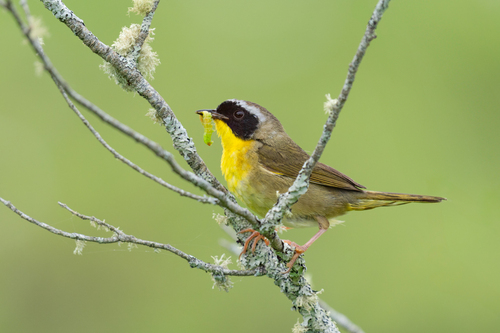
Common Yellowthroat
Geothlypis trichas
Meet the 'Yellow Bandit' of the brush—a charismatic warbler known for its bold black mask and rhythmic 'witchety' song. Common Yellowthroats bring a splash of tropical color and high-energy personality to wetlands and backyard thickets.
Quick Identification
Size
Length: 11–13 cm (4.3–5.1 in); Wingspan: 15–19 cm (5.9–7.5 in); Weight: 7–12 g (0.2–0.4 oz)
Colors
Males have a bright yellow throat and breast, olive upperparts, and a signature black facial mask bordered by a thin white-to-gray line. Females lack the mask and are generally olive-brown with a duller yellow throat.
Key Features
- Broad black 'bandit' mask (males only)
- Bright lemon-yellow throat and chest contrast with white belly
- Olive-green back and wings
- Nervous, frequent tail-flicking
- Preference for staying low in dense vegetation
When You’ll See Them
Geographic range
Where Does the Common Yellowthroat Live?
This vibrant warbler is native to the North American continent, with a vast breeding range that spans from the subarctic forests of southern Canada down to the central highlands of Mexico. While birds living in the southern United States and Mexico are often permanent residents, northern populations are long-distance migrants that travel to the Caribbean, Central America, and the Gulf Coast for the winter. They are incredibly adaptable, occupying almost any landscape from sea-level salt marshes to mountain meadows as long as there is dense, damp vegetation available.
Basemap © OpenStreetMap contributors
Behavior
The Common Yellowthroat is a high-energy 'skulker' that prefers the safety of dense undergrowth over the open canopy. You will often hear them before you see them; the male's loud, rhythmic 'witchety-witchety-witchety' song is a hallmark of North American wetlands. They move with quick, hopping motions, constantly searching for insects among the leaves and frequently cocking their tails upward in a wren-like fashion.
While they are relatively shy and quick to dive back into cover if startled, Common Yellowthroats are also intensely curious. They may emerge to the edge of a thicket to investigate a strange sound or an intruder. During the breeding season, they are fiercely territorial, with males using their bold masks and vocalizations to defend their patch of marsh or shrubland from rivals.
EverydayEarth exclusive
Camera Tips
To successfully capture a Common Yellowthroat on your backyard camera, you must understand their 'vertical' preference. These birds almost never visit high-hanging feeders; instead, they stay within three feet of the ground. Position your camera low—between knee and waist height—aiming at the edge of a dense thicket, a brush pile, or tall ornamental grasses. If you have a wetland or a pond on your property, focusing your camera on the transition zone between the water and the tall grass is a high-probability strategy.
Moving water is the ultimate 'lure' for this species. While they won't typically come to a bird feeder for seed, they are highly attracted to the sound of a solar-powered dripper or a low-profile birdbath. Set your camera near a water feature at ground level. Because they are fast-moving and small, use a camera with a fast trigger speed and set it to take a 3-5 photo burst or a short 10-second video clip. This increases your chances of getting a clear shot of the male's mask or the female's yellow throat before they dart back into the shadows.
Lighting can be a challenge because these birds love the shade. If possible, place your camera so it faces North or South to avoid direct lens flare, and look for a spot that receives 'dappled' sunlight in the early morning. The golden hours (6-9 AM) are when they are most active and vocal. During migration in May and September, keep your camera active even in suburban yards, as these birds will stop over in any garden that offers dense cover and a source of water.
Similar Species
Species that look similar or are commonly confused with Common Yellowthroat.
Frequently Asked Questions
Record Common Yellowthroat at your habitat
Connect a camera to start building your own species record — AI identifies every visitor automatically.