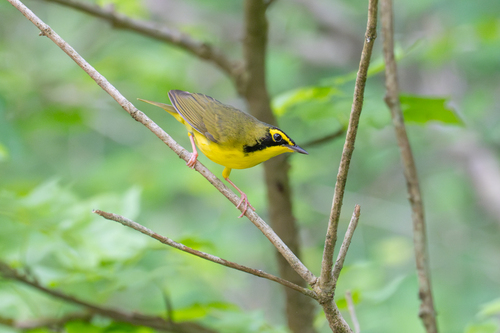
Kentucky Warbler
Geothlypis formosa
The Kentucky Warbler is a master of the forest floor, recognizable by its brilliant yellow breast and striking black 'spectacles.' Elusive and shy, this ground-walking songbird brings a touch of tropical color to the deep, moist woodlands of the Eastern United States.
Quick Identification
Size
Length: 12.5–13.2 cm (4.9–5.2 in); Wingspan: 20–22 cm (7.9–8.7 in); Weight: 13–16 g (0.46–0.56 oz)
Colors
Bright olive-green upperparts and vibrant yellow underparts. The face features a bold black 'mask' or 'spectacles' that connects the eye to the side of the neck, framed by yellow; females and immatures have similar but more muted patterns.
Key Features
- Bold yellow spectacles wrapping around the eye
- Deep black side-mask (less prominent in females)
- Heavy, dark bill and pinkish legs
- Uniform olive-green back with no wing bars
- Distinctive ground-walking (not hopping) movement
When You’ll See Them
Geographic range
Where Does the Kentucky Warbler Live?
Native to the Western Hemisphere, the Kentucky Warbler is a breeding resident of the Eastern and Central United States, ranging from the Gulf Coast up to the Great Lakes and eastward to the Mid-Atlantic. During the autumn months, these birds undertake a long-distance migration across the Gulf of Mexico. They spend their winter in the tropical evergreen forests of Central America and the northernmost regions of South America, including Colombia and Venezuela, preferring undisturbed interior forest habitats.
Basemap © OpenStreetMap contributors
Behavior
The Kentucky Warbler is a ground-dwelling specialist, often referred to as a 'skulker' due to its habit of staying hidden in dense, shadowy undergrowth. Unlike many of its warbler cousins that flit through the treetops, this species spends the vast majority of its time on the forest floor. It is one of the few warbler species that walks with a deliberate, rhythmic gait rather than hopping, frequently pausing to toss leaves aside in search of prey.
While they are notoriously shy and difficult to see, their presence is easily detected by their loud, musical song—a series of rolling two-syllable notes that sound like 'churry-churry-churry.' They are solitary and highly territorial during the breeding season. In their wintering grounds in the tropics, they are known to follow army ant swarms, opportunistic birds that snatch up insects flushed out by the ants.
EverydayEarth exclusive
Camera Tips
To capture a Kentucky Warbler on your backyard or trail camera, you must focus on the 'bottom' of the forest. Because these birds rarely fly high, place your camera very low to the ground—ideally between 6 and 12 inches high. Angle the lens slightly upward to capture the bird's underside and facial markings. Placing cameras near a pile of damp leaf litter or a small, naturally occurring puddle will significantly increase your chances of a sighting.
The most effective 'lure' for this species is a slow-dripping water feature. Kentucky Warblers are highly attracted to the sound of moving water for bathing and drinking, especially in the heat of midday. Use a solar-powered dripper over a shallow, stone-lined basin. Avoid standard tall bird baths; these ground-loving birds are much more likely to visit a feature that is level with the forest floor.
Set your camera to a high-speed trigger and multi-shot burst mode. Kentucky Warblers move with a jerky, rhythmic motion that can result in motion blur if the shutter speed isn't fast enough. Because they prefer deep shade, ensure your camera has excellent low-light performance or 'no-glow' infrared capabilities for the early morning hours when they are most active. Position the camera facing North or South to avoid direct sunlight blowing out the bright yellow feathers of their breast.
Similar Species
Species that look similar or are commonly confused with Kentucky Warbler.
Hooded Warbler
The Hooded Warbler has a complete black hood framing a yellow face and frequently flashes white outer tail feathers, which the Kentucky Warbler never does.
Common Yellowthroat
Yellowthroats have a much broader black mask that covers the forehead and eyes without the yellow 'spectacle' loop, and they prefer marshy, herbaceous habitats over deep forests.
Canada Warbler
The Canada Warbler features a 'necklace' of black spots across its chest and has distinct white eye-rings rather than the Kentucky's yellow spectacles and black face mask.
Frequently Asked Questions
Record Kentucky Warbler at your habitat
Connect a camera to start building your own species record — AI identifies every visitor automatically.