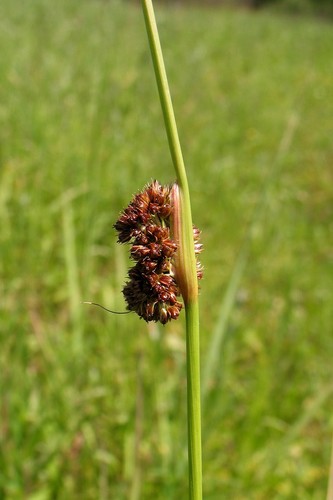
Compact Rush
Juncus conglomeratus
A structural masterpiece of the wetlands, the Compact Rush is easily identified by its tight, ball-like flower clusters and deeply grooved stems. It provides essential shelter for backyard amphibians and adds a touch of wild, architectural beauty to damp garden spots.
Quick Identification
Size
Stems typically reach 30 to 100 cm (12 to 39 inches) in height, forming dense, tufted clumps.
Colors
Bright green to grayish-green stems; flowers are reddish-brown, turning straw-colored as they mature.
Key Features
- Dense, ball-shaped flower clusters (conglomerated) located near the stem tip
- Distinctly ridged or striated stems, especially prominent just below the flowers
- Long, pointed bract that extends vertically, making the flower cluster appear to grow from the side of the stem
When You’ll See Them
Geographic range
Where Does the Compact Rush Live?
Native across a vast territory spanning Europe, North Africa, and Western Asia, the Compact Rush is a quintessential plant of the temperate Northern Hemisphere. It is particularly widespread throughout the United Kingdom and Scandinavia, thriving in cool, moist climates. It has also been introduced and successfully naturalized in parts of North America, New Zealand, and Australia, where it often colonizes disturbed wetland soils.
Basemap © OpenStreetMap contributors
Behavior
The Compact Rush is a hardy perennial that grows in dense, architectural tufts. Unlike many garden plants that wither under pressure, this species is incredibly resilient to trampling and grazing by livestock, which often allows it to become the dominant vegetation in damp pastures. It spreads slowly through a network of short, thick underground rhizomes, creating stable 'islands' of green even in very boggy or waterlogged ground.
While it remains stationary, it plays a dynamic role in the backyard ecosystem. Its stiff, upright stems provide a vertical playground for predatory insects like dragonflies and damselflies, which use the stems as perches to survey for prey. At the base of the clump, the thick accumulation of old stems creates a humid microhabitat that is highly attractive to amphibians and small invertebrates seeking shelter from the sun.
EverydayEarth exclusive
Camera Tips
To capture the best images of Compact Rush, place your camera on a low tripod or mount it roughly 12 to 15 inches from the ground. This low-angle perspective highlights the unique 'conglomerated' flower head against the sky, rather than letting it get lost against a background of green grass. If you are using an AI camera with macro capabilities, focus specifically on the area of the stem just below the flower cluster to capture the deep, corduroy-like ridges that distinguish this species from its cousins.
Time-lapse photography is the secret weapon for documenting this species. Set your camera to take a photo every 30 to 60 minutes during the early summer. Over a few weeks, you will see a fascinating transformation as the flower clusters burst forth and change from a subtle green to a rich, papery chestnut brown. This method also increases your chances of capturing 'guest stars' like snails, frogs, or beetles that utilize the rush as a climbing structure throughout the day.
Wind management is crucial when monitoring rushes. Because the stems are tall and flexible, they move constantly in the breeze, which can trigger thousands of false motion alerts on digital cameras. To solve this, lower your camera's motion sensitivity and use 'Detection Zones' to focus on the base of the plant. This allows you to ignore the swaying tops while still capturing the movement of small mammals or birds that might be foraging in the leaf litter at the plant's feet.
Similar Species
Species that look similar or are commonly confused with Compact Rush.
Frequently Asked Questions
Record Compact Rush at your habitat
Connect a camera to start building your own species record — AI identifies every visitor automatically.