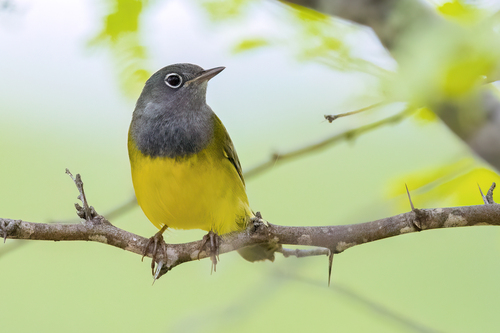
Connecticut Warbler
Oporornis agilis
A secretive ghost of the boreal bogs, the Connecticut Warbler is a master of the forest floor, distinguished by its rhythmic walk and striking gray hood.
Quick Identification
Size
Length: 13–15 cm (5.1–5.9 in), Wingspan: 22–25 cm (8.7–9.8 in), Weight: 12–19 g (0.4–0.7 oz)
Colors
Olive-green upperparts and yellow underparts; adult males feature a complete, slate-gray hood covering the head, neck, and upper breast; females and immatures have a similar but duller, brownish hood.
Key Features
- Complete, bold white eye-ring
- Pale pinkish-tan legs and feet
- Walks on the ground rather than hopping
- Exceptionally long undertail coverts
- Large, heavy-billed appearance for a warbler
When You’ll See Them
Geographic range
Where Does the Connecticut Warbler Live?
Native to the North American continent, the Connecticut Warbler primarily breeds within a narrow band of the boreal forest stretching from central Canada through the Great Lakes region of the United States. During the winter, these elusive birds undertake a massive migration to the humid tropical forests and shrublands of central South America, with significant populations concentrated in Brazil, northern Argentina, and Paraguay. They are known for a unique elliptical migration pattern, frequently appearing in the American Midwest during the spring and shifting toward the Atlantic coast during their autumn journey south.
Basemap © OpenStreetMap contributors
Behavior
The Connecticut Warbler is notoriously shy and secretive, often described by birders as a 'ghost' of the forest. Unlike many of its canopy-dwelling cousins, this species spends the vast majority of its time on the forest floor or in dense lower thickets. It has a distinctive way of moving; instead of hopping like most songbirds, it walks with a deliberate, rhythmic gait, often bobbing its tail slightly as it searches through leaf litter.
During the breeding season, males sing a loud, ringing 'free-cher, free-cher, free-cher' from mid-level branches, but they quickly drop back into the shadows if disturbed. Because they prefer incredibly dense vegetation and boggy terrain, they are rarely seen in open areas. They do not typically interact with humans and are considered one of the most difficult North American warblers to observe or photograph in the wild.
EverydayEarth exclusive
Camera Tips
To capture the Connecticut Warbler, you must think low. Because this species is almost exclusively a ground-walker, your camera should be mounted no higher than 6 to 12 inches off the forest floor. Aim the lens toward a natural clearing in dense, damp undergrowth or along the edge of a muddy thicket. Since they are so secretive, placing your camera near a slow-dripping water source or a very shallow, ground-level bird bath is often the only way to lure them into the frame during migration stops.
Lighting is a major challenge with this species, as they avoid bright sunlight. Set your camera to a higher ISO sensitivity or use a trigger that handles low-light 'deep shade' environments well. If your camera supports it, use a fast shutter speed; even though they walk rather than hop, their head movements while foraging are quick and can lead to motion blur in the dim light of their preferred habitats.
Timing is everything. In the spring, they are one of the latest warblers to migrate, often appearing in late May or early June. In the fall, they move through earlier than many expect, often peaking in early September. Because they are shy, avoid checking the camera frequently. Human scent and activity can cause them to abandon a foraging spot for several days. Using a cellular-enabled AI camera is ideal for this species, as it allows you to monitor sightings without disturbing the area.
Similar Species
Species that look similar or are commonly confused with Connecticut Warbler.
Mourning Warbler
Lacks the bold white eye-ring and typically hops rather than walks.
MacGillivray's Warbler
Has a broken white eye-ring (two arcs) and is found primarily in the western United States.
Nashville Warbler
Much smaller with a yellow throat; the Connecticut Warbler has a full gray or brown hood that covers the throat.
Frequently Asked Questions
Record Connecticut Warbler at your habitat
Connect a camera to start building your own species record — AI identifies every visitor automatically.