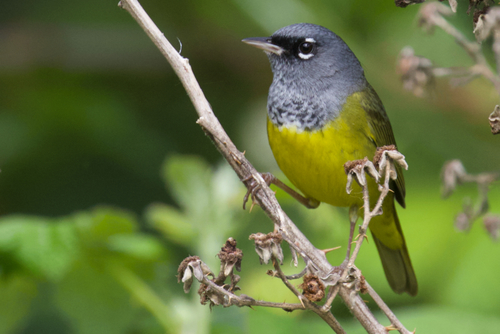
MacGillivray's Warbler
Geothlypis tolmiei
A secretive gem of the western thickets, MacGillivray's Warbler is a ground-dwelling beauty with a striking slate-gray hood and vibrant yellow belly.
Quick Identification
Size
Length: 12-15 cm (4.7-5.9 in); Wingspan: 19 cm (7.5 in); Weight: 9-13 g (0.3-0.5 oz)
Colors
Olive-green upperparts and vibrant yellow underparts. Both sexes feature a distinctive slate-gray hood. Males have black lores and a blackish patch on the breast; females have a paler gray throat. Both possess white 'eye-crescents' (a broken eye-ring).
Key Features
- Slate-gray hood contrasting with a bright yellow belly
- Broken white eye-ring appearing as top and bottom crescents
- Skulking, ground-dwelling behavior in dense brush
- Nervous, frequent tail-flicking
When You’ll See Them
Geographic range
Where Does the MacGillivray's Warbler Live?
This bird is a signature species of the Western North American wilderness. It breeds from the rugged coastlines of Southeast Alaska and British Columbia down through the Rocky Mountains and Pacific states into Northern Mexico. During the winter, the entire population migrates south to settle in the tropical shrublands and forest edges of Mexico and Central America, as far south as Panama. Because they favor moisture-rich environments, they are most frequently encountered in riparian zones and temperate mountain forests.
Basemap © OpenStreetMap contributors
Behavior
MacGillivray's Warblers are the quintessential 'skulkers' of the bird world. Unlike many of their warbler cousins that flit through the high canopy, these birds spend the vast majority of their time tucked away in the shadows of dense undergrowth. They move with a somewhat heavy and deliberate hopping motion, meticulously picking insects from the undersides of leaves or the ground. They are famously shy, often remaining out of sight even when singing their sharp, rolling song.
In a backyard setting, you won't see them at a traditional seed feeder. They are solitary and territorial during the breeding season, often displaying nervous energy through constant tail-flicking. They are highly sensitive to cover; if they feel exposed, they will quickly retreat into the deepest part of a thicket. Despite their elusive nature, they are common visitors to western gardens that offer the layered, 'messy' vegetation they crave for protection and foraging.
EverydayEarth exclusive
Camera Tips
To capture the elusive MacGillivray's Warbler, you must think low. These birds rarely venture more than a few feet off the ground, so mounting your AI-powered camera on a tripod or fence post just 1 to 2 feet above the soil is ideal. Position the camera to face into the 'edge' of a dense shrub or a brush pile. Avoid open lawn areas; instead, focus on the transition zone between your garden plants and the surrounding wilder vegetation.
The absolute best lure for this species is moving water. Because they are shy and won't visit standard bird feeders, a ground-level birdbath equipped with a solar dripper or a small, bubbling fountain is a magnet for them. Set your camera 3 to 5 feet away from the water source, ensuring the lens is angled to capture the bird as it hops toward the water. The sound of dripping or splashing water is often the only thing that will coax a MacGillivray's out of the deep shadows and into a clear camera frame.
Migration windows are your best opportunity for a high-quality capture. In the spring (late April and May) and late summer (August and September), these birds are moving through suburban backyards in higher numbers. During these times, they are slightly more visible as they search for high-protein insects to fuel their journey. Set your camera to its highest sensitivity and enable 'burst mode' or short video clips, as their movements are quick and nervous.
Lighting can be a challenge in the dense, shaded areas these birds prefer. If possible, position your camera so it is facing north or south to avoid direct sun glare, and try to utilize the 'golden hour'—the first two hours after sunrise—when these birds are most active and the light is soft enough to illuminate their yellow bellies without washing out the subtle gray of their hoods.
Similar Species
Species that look similar or are commonly confused with MacGillivray's Warbler.
Mourning Warbler
Almost identical but lacks the white eye-crescents and is typically found in Eastern North America.
Connecticut Warbler
Features a complete, unbroken white eye-ring and is notably larger and more sluggish in its movements.
Nashville Warbler
Has a complete white eye-ring and lacks the dark lores and black breast patches found on the male MacGillivray's.
Frequently Asked Questions
Record MacGillivray's Warbler at your habitat
Connect a camera to start building your own species record — AI identifies every visitor automatically.