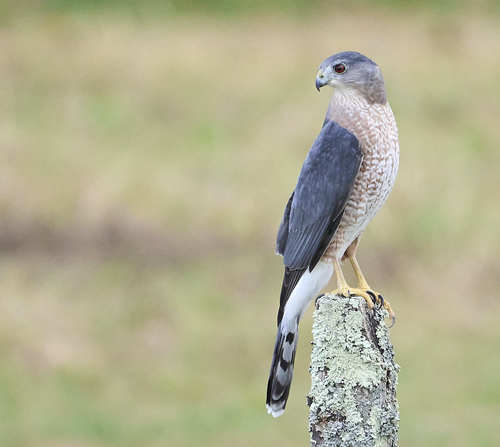
Cooper's Hawk
Astur cooperii
The 'fighter pilot' of the backyard, the Cooper's Hawk is a master of speed and agility, turning suburban gardens into its personal hunting grounds with breathtaking precision.
Quick Identification
Size
Length: 14–20 in (35–50 cm); Wingspan: 24–35 in (60–90 cm); Weight: 0.5–1.3 lbs (220–600 g)
Colors
Adults feature steely blue-gray upperparts and white underparts with fine reddish-orange barring. Juveniles are brown above with vertical brown streaks on the breast. Both have dark bands on the tail.
Key Features
- Long, rounded tail with thick dark bands and a prominent white tip
- Large, squared-off head with a dark cap
- Short, rounded wings designed for forest maneuverability
- Strong, thick legs and yellow-to-orange feet
When You’ll See Them
Geographic range
Where Does the Cooper's Hawk Live?
Where Does the Cooper's Hawk Live? This species is a true North American native, with a range that spans from the southern reaches of Canada across the entire United States and deep into Central Mexico. While many populations in the southern and coastal regions are year-round residents, those that breed in the northernmost forests of Canada often migrate south to the United States or Mexico for the winter. They are incredibly versatile, finding homes in both deep wilderness and the heart of bustling metropolitan areas where mature trees are present.
Basemap © OpenStreetMap contributors
Behavior
Cooper's Hawks are the elite aerial acrobats of the bird world, possessing a remarkable ability to navigate through dense branches at high speeds. Unlike many other hawks that soar in wide circles, the Cooper's Hawk is an ambush specialist. It often sits motionless on a concealed perch, waiting for the perfect moment to launch a lightning-fast pursuit of a songbird or small mammal. Their flight style is characterized by several quick wingbeats followed by a short glide.
In recent decades, these raptors have become highly adapted to human environments. They have learned that suburban bird feeders act as a 'supermarket' for their preferred prey. While they can be solitary and elusive in the wild, suburban individuals often become quite bold, frequently seen perching on backyard fences or low tree limbs. They are also known for their hygiene, often visiting large bird baths to soak and preen after a hunt.
EverydayEarth exclusive
Camera Tips
To capture a Cooper's Hawk on your AI-powered camera, you need to think like a hunter. The most successful camera placements are those that overlook 'staging areas' near bird feeders. Instead of pointing your camera directly at the feeder, aim it at a nearby fence post or a sturdy, horizontal tree branch. Cooper's Hawks will often land here first to survey the area before diving for a meal. Position the camera about 5-8 feet off the ground for these perching shots.
Another high-traffic area is a large, ground-level bird bath. Because Cooper's Hawks are larger than typical songbirds, they need a substantial water source for bathing. A wide, stone basin or even a small backyard pond is a magnet for them. Set your camera on a low tripod or mount it to a nearby stake about 12 inches off the ground to capture intimate, eye-level footage of them splashing. Use a fast trigger speed (0.5s or less) because their movements are explosive and unpredictable.
Lighting is key to getting a good ID. Try to position your camera facing away from the sun to highlight the 'cap' on their head and the orange barring on their chest. If your camera has a 'burst mode,' enable it; capturing 3-5 photos per trigger event increases your chances of getting a sharp image of the hawk in motion. During the winter, look for 'plucking posts'—stumps or logs where you see piles of feathers—as these are recurring meal spots where you can reliably capture feeding behavior.
Similar Species
Species that look similar or are commonly confused with Cooper's Hawk.
Frequently Asked Questions
Record Cooper's Hawk at your habitat
Connect a camera to start building your own species record — AI identifies every visitor automatically.