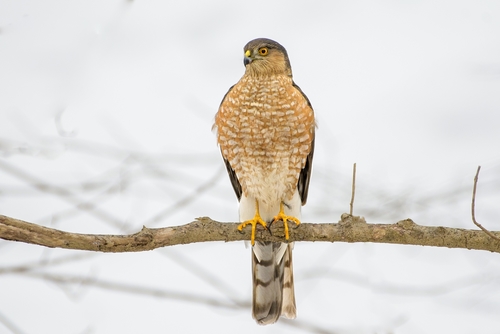
Sharp-shinned Hawk
Accipiter striatus
Meet the garden’s most agile aviator. The Sharp-shinned Hawk is a master of stealth and speed, bringing the raw energy of the wild forest directly to your backyard bird feeders.
Quick Identification
Size
Length: 9.4–13.4 in (24–34 cm); Wingspan: 16.9–22.1 in (43–56 cm); Weight: 3.1–7.7 oz (87–218 g). Females are notably larger than males.
Colors
Adults feature a blue-gray back and wings with reddish-orange horizontal barring on a white chest. Juveniles are brown above with vertical brown streaking on the underparts. Both have dark bands on the tail.
Key Features
- Small hawk with short, rounded wings and a very long tail
- Square-ended tail often with a small central notch
- Tiny head that barely extends past the 'shoulders' in flight
- Long, thin yellow legs (the 'sharp shins')
When You’ll See Them
Behavior
The Sharp-shinned Hawk is the ultimate forest acrobat, designed by nature for high-speed chases through dense vegetation. Unlike the soaring Red-tailed Hawk, 'Sharpies' rely on the element of surprise, staying low and using trees or garden shrubs as cover before launching a lightning-fast ambush on their prey. They are solitary hunters and can be surprisingly bold, often stalking backyard bird feeders where they capitalize on the concentration of songbirds.
During the breeding season, they are elusive and secretive, nesting deep within coniferous or mixed forests to avoid larger predators. However, during migration and winter, they become much more visible in suburban areas. Their flight pattern is a distinctive 'flap-flap-glide' sequence that helps birdwatchers identify them even from a distance. While they may seem aggressive due to their hunting habits, they are a vital part of a healthy ecosystem, keeping songbird populations fit and alert.
EverydayEarth exclusive
Camera Tips
To capture a Sharp-shinned Hawk on your AI camera, you don't necessarily bait the hawk—you bait the hawk's prey. Placing your camera near a well-stocked bird feeder is the most effective strategy. However, don't point the camera directly at the feeder; instead, aim it at a 'staging' branch or a nearby fence post. These hawks often perch for a few seconds to survey the area before striking, providing the perfect opportunity for a clear, still photograph.
Because these birds are incredibly fast, camera settings are crucial. Use the highest possible shutter speed and enable 'Burst Mode' or 'Multi-shot' if your device supports it. A Sharpie can enter and exit the frame in less than a second, so a fast trigger speed (under 0.5 seconds) is the difference between a great shot and a blurry wingtip. Mount your camera at a height of 5 to 8 feet, angled slightly downward to capture both the bird and the surrounding environment.
During the winter months, these hawks are more desperate for food and less wary of human structures. This is the best time to set up your gear. If you have a birdbath or a heated water feature, place a camera there as well; Sharp-shinned Hawks need to drink and bathe regularly, and a birdbath provides a rare moment of vulnerability where the bird will remain stationary for several minutes.
Consider the background of your shot. Since these hawks have intricate barring on their chests, a neutral or out-of-focus background (like a distant hedge) will make the bird's features pop. Avoid pointing the camera into direct sunlight, as the glare can wash out the subtle blue-gray tones of the adult's plumage. A North-facing placement usually provides the most consistent lighting throughout the day.
Similar Species
Species that look similar or are commonly confused with Sharp-shinned Hawk.
Cooper's Hawk
Larger with a more rounded tail and a prominent 'cap' of dark feathers on the head.
Merlin
A falcon rather than an accipiter, the Merlin has pointed wings and dark eyes rather than the hawk's red or yellow eyes.
American Kestrel
Much smaller with colorful blue-and-rufous plumage and distinctive black 'mustache' stripes on the face.
Frequently Asked Questions
Record Sharp-shinned Hawk at your habitat
Connect a camera to start building your own species record — AI identifies every visitor automatically.