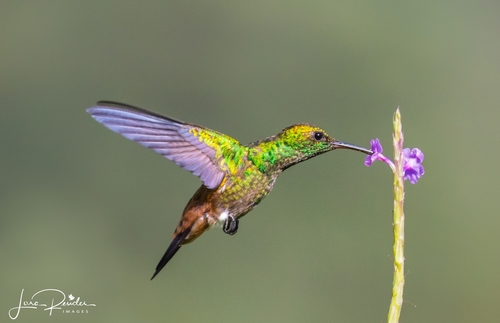
Copper-rumped Hummingbird
Saucerottia tobaci
A bold and territorial jewel of the Caribbean, the Copper-rumped Hummingbird dazzles with its metallic green plumage and namesake bronze tail.
Quick Identification
Size
9–11 cm (3.5–4.3 in) long; wingspan of approx. 12 cm (4.7 in); weighs 3.5–5 g (0.12–0.18 oz)
Colors
Brilliant iridescent green head and breast, transitioning to a distinct coppery-bronze rump; dark blue-black or violet-black tail.
Key Features
- Distinctive shimmering copper-colored lower back and rump
- Deep violet to blue-black notched tail
- Luminous green throat and underparts
- Small, straight bill with a slightly pale lower mandible
When You’ll See Them
Geographic range
Where Does the Copper-rumped Hummingbird Live?
This shimmering hummingbird is a native resident of the southern Caribbean and northern South America. Its most dense populations are found across the islands of Trinidad and Tobago, where it is often the most frequently sighted hummingbird species. Its range extends into northern Venezuela, spanning the coastal cordillera and the Orinoco Delta, and it is occasionally reported on the island of Grenada.
Basemap © OpenStreetMap contributors
Behavior
The Copper-rumped Hummingbird is a feisty and highly energetic resident of tropical landscapes. It is famously territorial, often claiming a specific flowering tree or bird feeder as its own and aggressively chasing away rivals, larger birds, and even large butterflies. Its flight is a marvel of agility, characterized by rapid wingbeats that produce a low humming sound and the ability to hover with precision while feeding.
In backyard settings, these birds are surprisingly bold. They are known to investigate humans wearing bright colors and will often return to the same favorite perches day after day. Their vocalizations consist of sharp, metallic "tsip" calls and a buzzy, repetitive song usually delivered from a high, exposed twig where they can keep a watchful eye on their territory.
EverydayEarth exclusive
Camera Tips
To capture the best footage of a Copper-rumped Hummingbird, focus your camera on a "sentinel perch." Because these birds are intensely territorial, they almost always have a favorite bare twig or wire near a food source where they sit to guard their nectar. Position your camera 3 to 5 feet from this perch at eye level (roughly 4 to 5 feet off the ground) to catch them in a still, regal pose rather than just a blur of motion.
Lighting is critical for bringing out the "copper" in their rump. Ensure your camera is oriented so the sun is behind the lens during peak morning hours. Direct sunlight hitting the bird's back will transform the feathers from a dull brown to a brilliant, glowing bronze. Avoid backlighting, which will turn the bird into a dark silhouette and hide its iridescent green throat.
Use a camera with a fast trigger speed and high-frame-rate video capabilities. These birds move faster than the human eye can track; a setting of 60fps or higher is recommended to capture the mechanics of their hovering. If using a feeder as bait, place the camera slightly to the side rather than directly in front of the ports to ensure the bird's profile and tail are visible, as they often fan their dark tails when banking away from a feeder.
Similar Species
Species that look similar or are commonly confused with Copper-rumped Hummingbird.
Frequently Asked Questions
Record Copper-rumped Hummingbird at your habitat
Connect a camera to start building your own species record — AI identifies every visitor automatically.