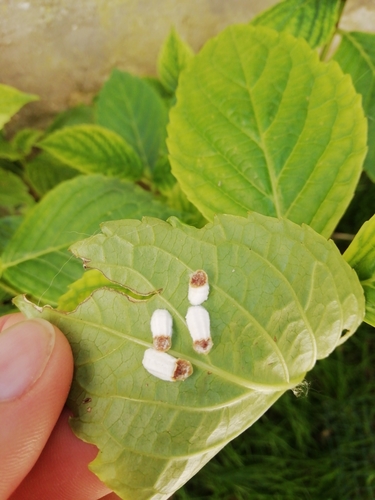
Cottony Hydrangea Scale
Pulvinaria kuwacola
Look closely at your garden shrubs and you might find what looks like tiny tufts of cotton. The Cottony Hydrangea Scale is a master of disguise, hiding beneath leaves and producing impressive waxy structures during the summer months.
Quick Identification
Size
Adult females are 3-5 mm (0.12-0.2 in) long; white egg sacs can reach 10 mm (0.4 in) in length.
Colors
Yellow-brown or pale tan body; bright white, waxy, ribbed egg sacs.
Key Features
- Flat, oval brownish body
- Long, white, cotton-like egg sac protruding from the rear
- Found on undersides of leaves and along stems
- Sticky honeydew residue on nearby foliage
When You’ll See Them
Geographic range
Where Does the Cottony Hydrangea Scale Live?
Native to East Asia, specifically Japan, Korea, and China, the Cottony Hydrangea Scale has become a successful globetrotter through the international plant trade. It is now widely established across much of Europe and has been introduced into parts of North America. It thrives in temperate and subtropical climates where its favorite host plants are commonly used in residential landscaping.
Basemap © OpenStreetMap contributors
Behavior
The Cottony Hydrangea Scale is a largely stationary insect for most of its adult life. After overwintering as immature nymphs on the twigs of their host plants, the females mature in late spring and begin to produce their most distinctive feature: a long, white, waxy egg sac known as an ovisac. These insects feed by piercing the plant tissue and sucking out phloem sap, which can weaken the host plant if the population is high.
As they feed, they excrete a sugary substance called honeydew. This sticky residue often coats the leaves below, providing a substrate for black sooty mold to grow. While they do not move much as adults, the newly hatched 'crawlers' are highly mobile, using their legs to find new feeding sites or even catching the wind to disperse to neighboring plants. They are generally considered a garden pest but provide a food source for various ladybug species and parasitic wasps.
EverydayEarth exclusive
Camera Tips
Capturing the Cottony Hydrangea Scale requires a macro lens or a camera capable of focusing at very short distances, as these insects are small and stationary. If you are using a backyard AI camera, mount it on a flexible tripod or arm that allows you to position the lens within inches of a hydrangea leaf or stem where the white egg sacs are visible. Because they don't move, motion-trigger settings may not work; instead, use a time-lapse mode to capture the slow expansion of the ovisac or the hatching of the tiny crawlers.
Lighting is crucial for these insects. The brilliant white waxy sacs reflect a lot of light and can easily appear 'blown out' or overexposed in direct sunlight. Position your camera to capture them in dappled shade or use a small diffuser to soften the light. Early morning or late afternoon provides the best natural contrast, highlighting the ribbed texture of the cottony sacs against the dark green of the leaves.
Check the undersides of leaves near the midrib and along the soft new growth of the stems. If you see ants crawling on your hydrangea, follow them—they are likely 'farming' the scale insects for their honeydew. Setting your camera to record 30-second clips every hour during the peak of June can reveal the fascinating interactions between the scales, the ants that protect them, and the ladybugs that try to eat them.
Similar Species
Species that look similar or are commonly confused with Cottony Hydrangea Scale.
Frequently Asked Questions
Record Cottony Hydrangea Scale at your habitat
Connect a camera to start building your own species record — AI identifies every visitor automatically.