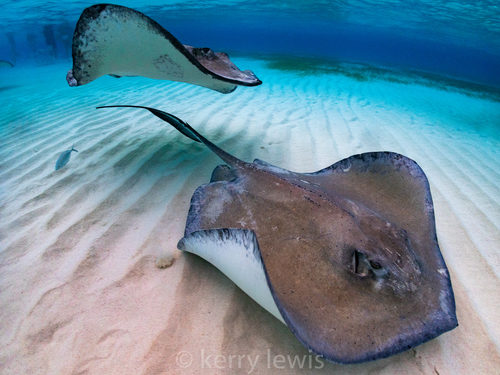
Southern Stingray
Hypanus americanus
The Southern Stingray is a master of camouflage, gliding through sun-drenched shallows and sandy flats with effortless grace. A favorite of coastal observers, this iconic ray offers a window into the hidden world of our Atlantic shorelines.
Quick Identification
Size
Disc width up to 1.5 meters (5 feet) for females, males are smaller at 0.7 meters (2.3 feet); weight up to 97 kilograms (214 lbs).
Colors
Dorsal side is typically mud brown, olive-green, or dark grey; ventral (underbelly) side is distinctively white with dark edges.
Key Features
- Diamond-shaped pectoral disc with pointed 'wing' tips
- Long, whip-like tail featuring a serrated, venomous barb
- Spiracles (breathing holes) located directly behind the eyes
- Prominent ridge on the tail both above and below the spine
When You’ll See Them
Behavior
Southern Stingrays are primarily benthic dwellers, meaning they spend the majority of their time on the seafloor. They have developed a fascinating survival strategy of burying themselves in the substrate to avoid predators like hammerhead sharks. By flapping their pectoral fins, they stir up sand to cover their bodies, leaving only their eyes and spiracles exposed to the water column.
While generally solitary hunters, these rays are known to be quite social in specific environments, particularly in 'stingray cities' or near coastal docks where human interaction is frequent. They are not naturally aggressive toward humans, but they are highly defensive. If stepped on or cornered, they will whip their tail upward to strike with their venomous barb.
EverydayEarth exclusive
Camera Tips
Capturing the Southern Stingray requires a specialized approach since they are aquatic. If you have a waterfront property with a dock or pier, the best setup is a submerged, waterproof action camera or a dedicated underwater trail camera. Mount the camera to a dock piling approximately 1 to 2 feet above the sandy bottom, angled slightly downward. This 'eagle-eye' view is perfect for capturing the ray's diamond silhouette as it glides over the substrate.
Lighting is your biggest challenge underwater. If your camera doesn't have powerful infrared (IR) capabilities, consider installing a motion-activated green or white underwater dock light. These lights not only help the camera's sensor 'see' the ray but also attract small fish and crustaceans, which in turn brings the stingray into the frame to hunt. Set your camera to record video rather than still photos, as the fluid motion of a ray's 'wings' is much more distinctive and easier for AI detection models to identify than a static image of a ray partially buried in sand.
Timing is critical. While they can be seen during the day, Southern Stingrays are most active at night. Focus your monitoring during the rising tide, as rays often move into shallower flats and closer to shorelines to forage. If you are using a camera with a motion trigger, be aware that floating debris or schools of small baitfish may cause false triggers; adjusting the sensitivity to 'medium' usually helps filter out the smaller movements while still capturing the large mass of a passing ray.
During the summer months, keep a lookout for smaller rays in very shallow water. This is often the time when juveniles stay close to shore for protection. If you notice 'craters' in the sand in front of your camera, it is a sign that a ray has been foraging there recently—keep your camera in that specific spot, as they often return to productive hunting grounds night after night.
Similar Species
Species that look similar or are commonly confused with Southern Stingray.
Frequently Asked Questions
Record Southern Stingray at your habitat
Connect a camera to start building your own species record — AI identifies every visitor automatically.