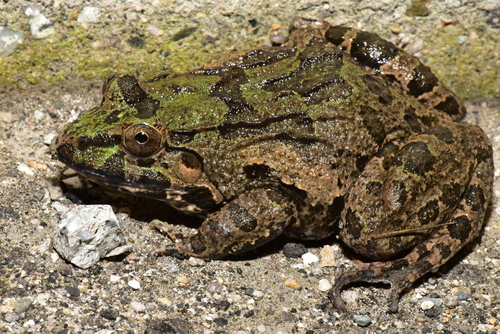
Crab-eating Frog
Fejervarya cancrivora
The Crab-eating Frog is the ultimate coastal survivor, famously known as the only amphibian that can thrive in the salty waters of mangroves and sea marshes. Watch as this nocturnal hunter prowls the shoreline for its namesake prey.
Quick Identification
Size
Body length typically 5–8 cm (2–3 in) for males, with larger females reaching up to 12 cm (4.7 in); weight ranges from 40–120g (1.4–4.2 oz)
Colors
Mottled olive-brown, grey, or charcoal upper body with dark irregular blotches; pale cream or white belly; dark bars often visible on the legs and lips
Key Features
- Distinct longitudinal skin folds or ridges along the back
- Extensive webbing on the hind toes reaching the tips
- Pointed snout with a frequent pale stripe running down the spine
When You’ll See Them
Geographic range
Where Does the Crab-eating Frog Live?
Native to the vibrant coastal ecosystems of Southeast Asia, the Crab-eating Frog's range stretches from the eastern coast of India and southern China through the Malay Peninsula to the many islands of Indonesia and the Philippines. This species is a lowland specialist, almost exclusively found near sea level where land meets the tide. Beyond its native shores, it has also established a successful introduced population on the island of Guam, demonstrating its incredible ability to colonize new tropical coastal environments.
Basemap © OpenStreetMap contributors
Behavior
The Crab-eating Frog is a remarkable biological anomaly, being one of the very few amphibians capable of surviving in brackish and salt water. Unlike most frogs whose skin would lose vital moisture to the salt, this species can increase the urea levels in its blood to balance osmotic pressure. They are predominantly nocturnal, spending their days hiding in crevices, under coastal debris, or in burrows to avoid the tropical sun, emerging at twilight to hunt along the water's edge.
During the breeding season, which often coincides with the onset of the monsoon rains, males gather in brackish pools to call for mates with a series of short, raspy croaks. While they are generally solitary and wary of human presence, they have adapted well to human-altered landscapes, often being found in coastal rice paddies and roadside ditches near the sea. They are skilled swimmers and powerful jumpers, using their strong hind legs to escape into the water or thick mangrove roots when threatened.
EverydayEarth exclusive
Camera Tips
To capture the Crab-eating Frog on camera, placement is everything. Focus your camera on the 'intertidal zone' of your backyard or local coastal patch—specifically near brackish ponds, slow-moving drainage ditches, or the edges of mangrove roots. Because these frogs are relatively small, mount your camera very low to the ground, no more than 6 to 10 inches high, and angle it slightly downward to capture the ground-level action. If your camera allows for macro-focusing or has a close-up lens attachment, use it to ensure the frog's skin textures and ridges remain sharp.
Since this species is strictly nocturnal, a camera with high-quality infrared (no-glow) LEDs is essential to avoid startling the animal. Set your PIR (passive infrared) sensor to the highest sensitivity; frogs are cold-blooded and may not always trigger sensors designed for warm-blooded mammals unless they are moving actively. Using a 'Burst Mode' of 3-5 photos or short 15-second video clips is highly recommended to catch the quick, snapping tongue movements when they are feeding on crabs.
If you are trying to attract them to a specific spot for a photo, creating a small 'frog pond' with slightly brackish water and low-wattage solar lights can help. The lights will attract insects and small crabs, which in turn will bring the Crab-eating Frog right into your camera's field of view. Ensure your camera housing is rated for high humidity and salt-spray resistance, as the coastal air can be corrosive to electronic equipment over time. Check your equipment weekly to wipe the lens of salt crust or condensation.
Similar Species
Species that look similar or are commonly confused with Crab-eating Frog.
Frequently Asked Questions
Record Crab-eating Frog at your habitat
Connect a camera to start building your own species record — AI identifies every visitor automatically.