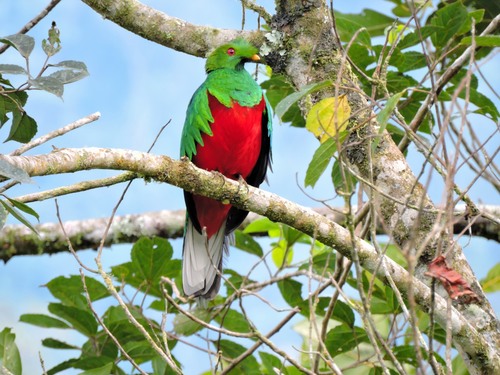
Crested Quetzal
Pharomachrus antisianus
A shimmering emerald of the Andes, the Crested Quetzal is a crown jewel of the South American cloud forest. With its striking scarlet belly and distinctive fuzzy crest, this elusive trogon is a dream find for any high-altitude wildlife watcher.
Quick Identification
Size
Length: 35–40 cm (14–16 inches); Weight: 150–200 g (5.3–7.1 oz)
Colors
Males are iridescent emerald green above with a brilliant red belly and white undertail feathers; females have a greyish-brown head and breast with a smaller red belly patch.
Key Features
- Short bushy crest rising from the forehead
- Metallic green plumage with a bright scarlet belly
- Large dark eyes and a short yellow bill in males
- White outer tail feathers visible during flight or from below
When You’ll See Them
Geographic range
Where Does the Crested Quetzal Live?
The Crested Quetzal is a native resident of the South American continent, specifically inhabiting the lush slopes of the Andes Mountains. Its core range spans through Venezuela, Colombia, Ecuador, and Peru, extending as far south as the yungas of Bolivia. It is strictly a high-altitude specialist, rarely found outside of the mist-shrouded forests of these five Andean nations.
Basemap © OpenStreetMap contributors
Behavior
The Crested Quetzal is a master of the 'sit-and-wait' strategy. Often perched motionless for long stretches, they can be remarkably difficult to spot despite their vibrant colors. They are most active during the early morning hours when they move between fruiting trees, occasionally performing acrobatic sally-flights to pluck fruit or insects from the foliage.
These birds are generally solitary or found in pairs, though several individuals may congregate at a particularly productive wild avocado tree. They communicate with a series of low, rhythmic 'whe-oo, whe-oo' calls that echo through the misty canopy. While they are not overly aggressive toward humans, they are shy and will quickly retreat into thicker cover if they feel exposed.
EverydayEarth exclusive
Camera Tips
To capture a Crested Quetzal on a trail camera, focus your efforts on the mid-canopy level rather than the ground. If you have a backyard bordering an Andean cloud forest, look for Lauraceae trees (wild avocados). Mount your camera 10–15 feet high using a tree-climbing kit or a sturdy ladder, angling the lens toward a branch that provides a clear view of ripening fruit. These birds have favorite 'perching branches' where they sit to digest food; look for areas with droppings and large seeds on the ground below to identify these spots.
Since these birds inhabit dim, misty environments, camera settings are crucial. Use a camera with a high-quality CMOS sensor that handles low-light well. Set your trigger speed to the fastest possible setting (0.2 seconds or less) to catch them as they sally forth for fruit. If your camera allows, use a higher ISO (up to 800) to ensure the shutter speed stays fast enough to freeze motion in the shadows of the canopy.
Video mode is highly recommended for this species. The Crested Quetzal's beauty is best captured in motion, as the light hits their iridescent feathers and they perform their characteristic tail-flicking. Set your camera to record 20-30 second clips. If you are using a bait strategy, planting native fruiting trees like those in the Lauraceae family is the most effective long-term 'lure,' as these birds are unlikely to visit traditional bird feeders.
Similar Species
Species that look similar or are commonly confused with Crested Quetzal.
Frequently Asked Questions
Record Crested Quetzal at your habitat
Connect a camera to start building your own species record — AI identifies every visitor automatically.