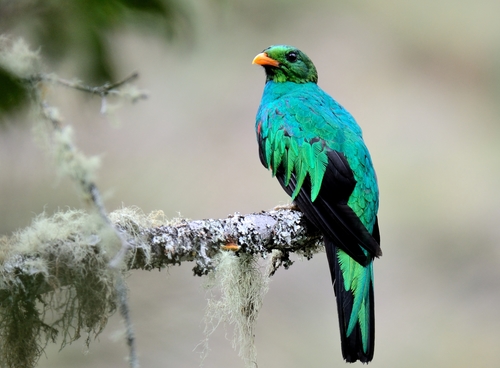
Golden-headed Quetzal
Pharomachrus auriceps
A shimmering jewel of the Andean cloud forest, the Golden-headed Quetzal captivates with its brilliant emerald plumage and its crown of burnished gold.
Quick Identification
Size
Length: 33–36 cm (13–14 inches); Wingspan: Approx. 55–60 cm (22–24 inches); Weight: 150–180 grams (5.3–6.3 oz)
Colors
Brilliant iridescent green body; males have a distinctive golden-bronze head and bright red belly; females have a brownish-grey head and duller red lower belly.
Key Features
- Golden-bronze iridescent crown and nape
- Bright red belly contrasting with green breast
- Black underside of the tail feathers
- Yellow bill (brighter in males)
When You’ll See Them
Geographic range
Where Does the Golden-headed Quetzal Live?
The Golden-headed Quetzal is native to the lush montane regions of Central and South America. Its range begins in the eastern highlands of Panama and extends south through the Andes mountains into Colombia, Venezuela, Ecuador, and Peru, eventually reaching northern Bolivia. It is a specialist of the humid cloud forest belt, restricted to these mountainous corridors where the moisture levels support the epiphytes and fruit trees it relies on.
Basemap © OpenStreetMap contributors
Behavior
The Golden-headed Quetzal is a relatively sedentary and quiet inhabitant of the high-altitude canopy. It spends much of its day perched upright on moss-covered branches, staying remarkably still while scanning for fruit or insects. Despite its vibrant colors, its green upperparts provide excellent camouflage against the foliage of the cloud forest, making it more often heard than seen.
These birds are primarily solitary outside of the breeding season. They are best known for their 'sallying' foraging technique, where they fly out from a perch to snatch a fruit or insect in mid-air before returning to a branch to eat. While they are not particularly fearful of humans, their preference for the high canopy of primary forests means they rarely interact with people unless observed by quiet hikers or birdwatchers.
EverydayEarth exclusive
Camera Tips
To successfully capture a Golden-headed Quetzal on camera, height is your most important factor. These are canopy-dwelling birds, so mounting your camera at ground level is unlikely to yield results. Look for a location where the terrain allows you to angle a camera toward the mid-story of the forest, such as a steep hillside or a balcony overlooking a ravine. Target 'feeding trees'—specifically wild avocados or other fruiting trees—where the birds are known to congregate during the morning hours.
Camera settings should prioritize a fast shutter speed or high frame-rate video (60fps or higher). Quetzals move with a sudden, explosive burst when they dive for fruit, and a standard trail camera may only catch a green blur if the trigger speed is slow. Using a camera with a high-quality CMOS sensor is vital because the deep shade of the cloud forest can create grainy images in the low-light conditions of early dawn when the birds are most active.
If you are monitoring a specific property, listen for their melancholic, rising whistle to identify their favorite perching spots. Unlike many backyard birds, quetzals will not come to traditional bird feeders; however, they may be attracted to properties that have preserved native fruiting trees. Ensure your camera housing is well-sealed and include a desiccant pack inside, as the 90%+ humidity of their natural habitat can quickly lead to lens fogging or electronics failure.
Similar Species
Species that look similar or are commonly confused with Golden-headed Quetzal.
Resplendent Quetzal
Has much longer tail streamers in males and white feathers on the underside of the tail.
Crested Quetzal
Features a distinct upright crest on the forehead and more white in the tail feathers.
White-tipped Quetzal
Smaller in size with prominent white tips on the outer tail feathers.
Frequently Asked Questions
Record Golden-headed Quetzal at your habitat
Connect a camera to start building your own species record — AI identifies every visitor automatically.