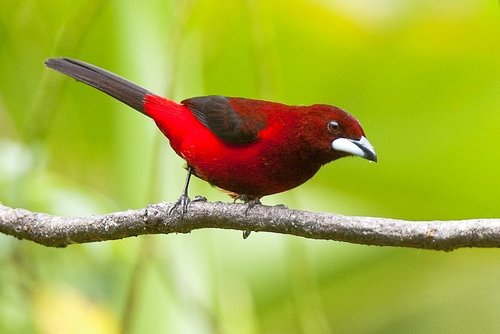
Crimson-backed Tanager
Ramphocelus dimidiatus
Known locally as 'Sangre de Toro' for its intense blood-red plumage, the Crimson-backed Tanager is a jewel of the tropical lowlands. This social songbird brings a burst of vibrant color and lively energy to any backyard or forest clearing it visits.
Quick Identification
Size
Length: 16–18 cm (6.3–7 in); Weight: 24–31 g (0.8–1.1 oz)
Colors
Males are a deep, velvety crimson on the head, back, and underparts with black wings and tail; females are brownish-red or ochre-toned.
Key Features
- Velvety crimson body on males
- Striking silver-white lower mandible on males
- Deep black wings and tail
- Active, social group behavior
When You’ll See Them
Sightings on EverydayEarth
Jul 29, 2026
A Palm Tanager is perched on the fruit tray, feeding on sliced oranges and bananas. About eleven seconds into the video, a male Crimson-backed Tanager lands on the left side of the tray to join the feast.
Jul 29, 2026
A male Crimson-backed Tanager is perched on the right side of the fruit feeder platform. It briefly investigates the available fruit before flying out of the frame.
Jul 28, 2026
A Crimson-backed Tanager is perched on the feeder tray, actively feeding on a piece of papaya. A second, smaller bird—a male Thick-billed Euphonia—flies in and lands on the opposite side of the tray to join the feeding activity.
Jul 28, 2026
A male Crimson-backed Tanager perches briefly on a mossy branch beside the feeder platform. It surveys the area, its vibrant red plumage and silvery lower mandible catching the light, before hopping down into the surrounding foliage.
Jul 25, 2026
A group of tropical birds gathers at a fruit feeder platform. A Clay-colored Thrush and a Palm Tanager are already present when a male Crimson-backed Tanager arrives from the lower left. The birds actively feed on halved oranges and papaya, hopping between pieces of fruit and occasionally looking around at the lush jungle surroundings.
Jul 24, 2026
A Crimson-backed Tanager is perched on the feeder platform, focusing its attention on a slice of papaya. It pecks at the fruit several times, occasionally shifting its stance and looking around before continuing to feed.
Geographic range
Where Does the Crimson-backed Tanager Live?
This vibrant songbird is native to the tropical lowlands of Central and South America, with its core populations concentrated in Panama, Colombia, and Venezuela. Within these regions, it is a common sight in both wild landscapes and human-altered environments like coffee plantations and backyard gardens. Additionally, a stable population was introduced to the island of Tahiti in French Polynesia, where the species has successfully naturalized in the local ecosystem.
Basemap © OpenStreetMap contributors
Recorded on EverydayEarth
Behavior
The Crimson-backed Tanager is a highly social and energetic bird, often found traveling in small family groups or noisy flocks of up to a dozen individuals. They are active foragers, spending much of their day hopping through low to mid-level vegetation in search of food. While they are bold and vocal among their own kind, they can be somewhat flighty around humans, though they adapt remarkably well to suburban environments and gardens near forest edges.
These birds are particularly fond of fruit and will frequently visit bird feeders, where they may display a social hierarchy. Their movements are quick and jerky, characteristic of the Ramphocelus genus. During the breeding season, males become more conspicuous, perching on exposed branches to sing a series of rhythmic, chirping notes to defend their territory or attract a mate.
EverydayEarth exclusive
Camera Tips
To capture the stunning 'sangre de toro' color of the Crimson-backed Tanager, place your AI-powered camera near fruiting trees or active bird feeders. They are particularly drawn to bananas, papayas, and oranges. Mount the camera at eye level—roughly 4 to 6 feet high—on a stable post or branch facing the feeding station. Because these birds are quick and move with jerky motions, use a high shutter speed or 'burst mode' to ensure you catch the sharp silver glint of the male's lower mandible without motion blur.
Angle your camera to take advantage of the morning light; the 7:00 AM to 10:00 AM window provides the best natural illumination to make their crimson feathers pop against green foliage. Avoid placing the camera in direct, harsh midday sun, which can wash out the deep red tones and create high-contrast shadows that obscure their features. If you are using a trail camera in a more wooded area, look for forest gaps or 'light wells' where the birds often congregate to sun themselves or forage for insects among the leaves.
Because they often travel in family groups, wide-angle settings are preferable to capture multiple birds at once. These tanagers are quite curious and may approach the camera if it is positioned near a water source like a birdbath. Ensure the camera is at least 3-5 feet away from the water to maintain focus while catching their splashing behavior. In suburban settings, they are year-round residents, so keeping a consistent feeding schedule will train them to visit your camera site daily, providing frequent high-quality captures.
Similar Species
Species that look similar or are commonly confused with Crimson-backed Tanager.
Frequently Asked Questions
Record Crimson-backed Tanager at your habitat
Connect a camera to start building your own species record — AI identifies every visitor automatically.