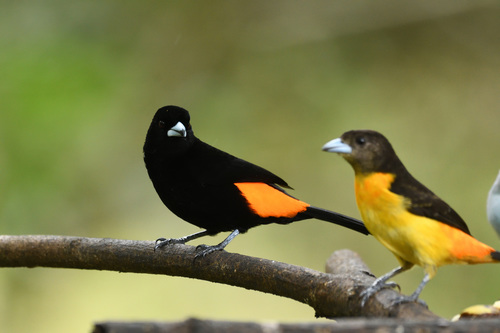
Flame-rumped Tanager
Ramphocelus flammigerus
A jewel of the Colombian Andes, the Flame-rumped Tanager dazzles with its velvety black plumage and a rump that glows like a hot coal. Frequent visitors to gardens and forest edges, these social birds bring a spark of fire to the tropical canopy.
Quick Identification
Size
18-19 cm (7-7.5 inches) in length; weighs approximately 28-33 grams
Colors
Males are velvety black with a brilliant fire-red or bright orange rump. Females are olive-brown with a pale yellow or orange-yellow rump and underparts.
Key Features
- Velvety black body with a contrasting brilliant red or orange lower back
- Thick, silver-blue bill with a dark tip
- Pale yellow or white iris that stands out against dark plumage
- Frequent tail-flicking and fanning behavior
When You’ll See Them
Geographic range
Where Does the Flame-rumped Tanager Live?
This stunning tanager is a South American treasure, found exclusively within the lush borders of western Colombia. Its native range is concentrated along the Dagua and Cauca river valleys, as well as the western slopes of the Andes mountains. Because it prefers semi-open habitats over dense, primary rainforest, it has actually benefited from moderate land clearing and is frequently seen in rural landscapes and urban outskirts throughout its regional territory.
Basemap © OpenStreetMap contributors
Behavior
Flame-rumped Tanagers are energetic and highly social birds, often found in small family groups or pairs as they move through the middle and upper levels of the canopy. They are known for their lively and somewhat noisy nature, frequently giving off sharp metallic chirps as they forage. In suburban settings, they adapt well to human presence, often visiting fruiting trees in gardens or parks.
These birds exhibit a characteristic 'fanning' behavior with their tails when excited or during territorial displays. While they can be bold around food sources, they remain alert to predators, often retreating to dense thickets if disturbed. Their flight is undulating and direct, making them a common sight in the semi-open landscapes of the Colombian Andes.
EverydayEarth exclusive
Camera Tips
To capture the vibrant Flame-rumped Tanager on camera, focus on 'edge' environments where dense cover meets open space. Position your AI-powered camera near native fruiting trees like Miconia or Cecropia, which are magnet plants for these birds. Because they are mid-story foragers, mount your camera between 5 to 10 feet off the ground, angled slightly downward toward a stable branch or a bird feeder platform.
If you are using a backyard setup, offering overripe bananas or halved papayas is an almost guaranteed way to draw them into view. These tanagers are social, so if you see one, keep the camera rolling; a mate or juvenile is likely to follow shortly. Since their plumage is a deep velvety black, try to place your camera in a spot with soft, diffused morning light to prevent the highlights on the rump from 'blowing out' while still capturing detail in the dark feathers.
For the best AI triggers, set your camera to high sensitivity and use a short burst mode. These birds move quickly and frequently flick their tails, which can lead to blurry shots if the shutter speed is too slow. A fast trigger speed is essential to catch that split-second when they flare their brilliant red rump feathers during a display or a takeoff.
Similar Species
Species that look similar or are commonly confused with Flame-rumped Tanager.
Frequently Asked Questions
Record Flame-rumped Tanager at your habitat
Connect a camera to start building your own species record — AI identifies every visitor automatically.