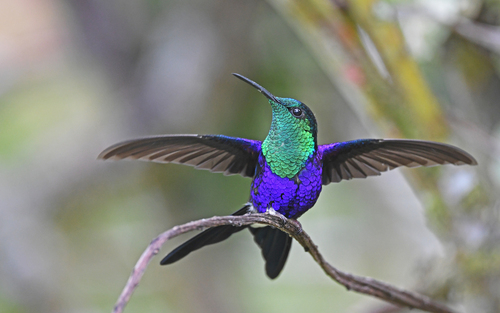
Crowned Woodnymph
Thalurania colombica
A glittering jewel of the Neotropical understory, the Crowned Woodnymph dazzles with its violet crown and emerald throat. This territorial dynamo is a frequent visitor to forest edges and tropical gardens across Central and South America.
Quick Identification
Size
9.5–11 cm (3.7–4.3 in) in length; 3.5–5.4 g (0.12–0.19 oz) in weight
Colors
Males: Violet crown, upper back, and belly with emerald throat. Females: Greenish above with pale grey underparts and white-tipped tail.
Key Features
- Glittering violet crown and belly on males
- Deeply forked blue-black tail
- Emerald green iridescent throat
- Medium-length, slightly decurved black bill
When You’ll See Them
Geographic range
Where Does the Crowned Woodnymph Live?
The Crowned Woodnymph is native to the lush Neotropical regions of Central and South America. Its range begins in the southern reaches of Belize and Guatemala, extending through the humid corridors of Costa Rica and Panama into the northern Andean regions of Colombia, Ecuador, and Peru. While primarily a forest dweller, it is increasingly found in suburban gardens and shaded coffee plantations that provide adequate floral resources.
Basemap © OpenStreetMap contributors
Behavior
The Crowned Woodnymph is a highly energetic and territorial hummingbird known for its aggressive defense of nectar sources. While they often follow a "traplining" route—visiting a series of flowers in a specific order—they are quick to abandon this routine to fiercely guard a particularly rich patch of flowers or a garden feeder. They are agile fliers, capable of hovering with precision and darting at high speeds to chase off intruders, including much larger bird species.
In social terms, they are solitary except during the brief mating period. They are often found at varying heights within the forest, from the dark understory where they hunt for tiny insects to the bright canopy where they forage for nectar. Their interaction with humans is generally characterized by a bold curiosity; they are known to approach garden feeders even while people are nearby, provided there is sufficient cover nearby for a quick retreat.
EverydayEarth exclusive
Camera Tips
To capture the stunning iridescence of the Crowned Woodnymph, placement is everything. Position your camera near red or orange tubular flowers, such as Heliconia or hibiscus, which act as natural magnets. If using a feeder, place it in a spot that receives dappled sunlight; direct, harsh noon sun can wash out their colors, while a bit of side-lighting will make the male's violet crown and emerald throat shimmer vividly.
Because these birds move with incredible speed, use the highest shutter speed your camera allows. If your AI-powered camera has a "Bird" or "High-Speed" mode, ensure it is active to reduce motion blur during wing beats. A trigger distance of 3 to 5 feet is ideal for hummingbirds; any further and they become a mere speck, any closer and you might struggle with focal depth as they hover and dart.
Consider the background when setting up your camera. A dark, out-of-focus foliage background will make the glittering colors of the Woodnymph pop. Since they are territorial, if you see one individual frequently, try to identify its favorite 'perch'—usually a thin, bare twig near a food source—where it sits to survey its kingdom. Setting a camera trap focused on this perch often yields the most crisp, still portraits.
Similar Species
Species that look similar or are commonly confused with Crowned Woodnymph.
Frequently Asked Questions
Record Crowned Woodnymph at your habitat
Connect a camera to start building your own species record — AI identifies every visitor automatically.