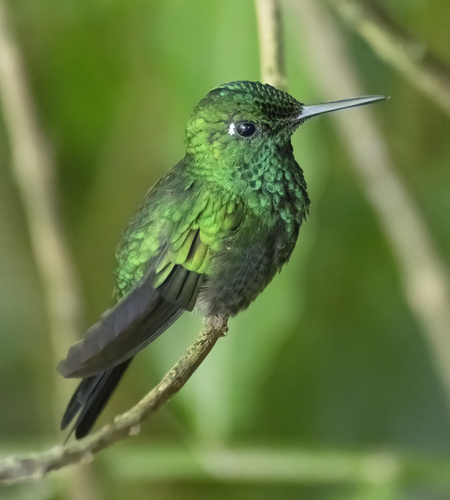
Green-crowned Brilliant
Heliodoxa jacula
A glittering emerald gem of the cloud forest, the Green-crowned Brilliant is a bold, large hummingbird famous for its iridescent plumage and assertive nature at the feeder.
Quick Identification
Size
12–13 cm (4.7–5.1 in) long; weight 8–9.5g (0.28–0.34 oz)
Colors
Male is glittering emerald green with a small violet-blue throat patch and blue-black forked tail. Female has white underparts heavily spotted with green and a white stripe behind the eye.
Key Features
- Large, robust hummingbird build
- Glittering green crown and breast
- Small violet-blue throat patch on males
- White 'mustache' and post-ocular spot on females
When You’ll See Them
Geographic range
Where Does the Green-crowned Brilliant Live?
South and Central America are the native homes of this stunning hummingbird. Its core range extends from the misty highlands of Costa Rica and Panama down through the Andean slopes of Colombia and western Ecuador. It is a resident of middle-elevation cloud forests and is rarely found in lowland coastal areas, preferring the cooler, humid climates of the mountains.
Basemap © OpenStreetMap contributors
Behavior
The Green-crowned Brilliant is a powerhouse of the cloud forest, known for its bold and somewhat aggressive temperament. Unlike many smaller hummingbirds that hover incessantly, this species frequently perches or clings to flowers while feeding, a behavior made possible by its larger size and strong feet. It is a 'trap-liner,' meaning it follows a specific, repeatable route between flowering plants throughout the day to ensure a steady supply of nectar.
In backyard settings or at nature lodges with feeders, they often dominate smaller species, asserting their presence with sharp, squeaky calls. While they are not overly shy around humans, they maintain a focused intensity when feeding, often ignoring observers if a reliable nectar source is available. They are generally solitary but will congregate in high-density feeding areas where they spend significant energy defending their favorite nectar sources.
EverydayEarth exclusive
Camera Tips
To capture the Green-crowned Brilliant, position your AI camera at eye level near high-volume nectar sources like red tubular flowers or specialized hummingbird feeders. Because these birds are larger and frequently perch while feeding, look for 'staging' branches nearby—small, bare twigs where they sit to survey the area before diving in to feed. Aiming your camera at these perches often results in clearer, more stable shots than trying to catch them in mid-flight.
Since they inhabit cloud forests where light can be dim and diffused, prioritize a high shutter speed if your camera allows manual overrides, or ensure your setup is in a spot that receives bright, indirect light. Positioning the camera so the sun is behind you will help illuminate the iridescent green 'brilliance' of their crown and throat, which can otherwise appear as a dull black in heavy shadow or backlight.
For the best results, use a camera with a high-speed trigger or video mode. These birds move with incredible speed, and a single still frame often misses the perfect wing position. If you are using a backyard feeder, try adding a small natural branch as a perch just below the nectar ports; the Green-crowned Brilliant is much more likely than other species to land and stay still for several seconds, providing an excellent window for high-resolution captures and identification of the male's violet throat patch.
Similar Species
Species that look similar or are commonly confused with Green-crowned Brilliant.
Frequently Asked Questions
Record Green-crowned Brilliant at your habitat
Connect a camera to start building your own species record — AI identifies every visitor automatically.