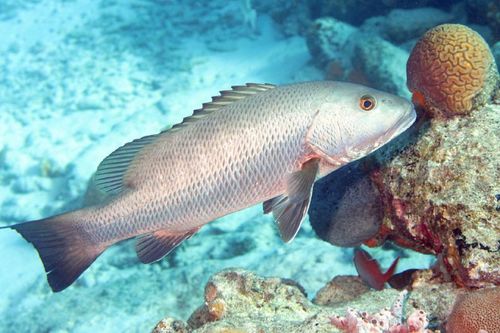
Cubera Snapper
Lutjanus cyanopterus
The ultimate reef heavyweight, the Cubera Snapper is a nocturnal giant known for its massive canine teeth and elusive nature. It is the prize of the Atlantic, ruling the shadows of rocky ledges and mangrove roots.
Quick Identification
Size
Averages 60–90 cm (24–35 in), but can reach 160 cm (63 in); weights typically 18–36 kg (40–80 lbs) up to 57 kg (125 lbs).
Colors
Dark grey to dark brown body with a reddish or bronze tint; juveniles may exhibit pale vertical bars along the flanks.
Key Features
- Massive canine teeth visible even when mouth is shut
- Exceedingly thick, fleshy lips
- Truncate or slightly emarginate (square-cut) tail
- Large, heavy-scaled robust body
When You’ll See Them
Geographic range
Where Does the Cubera Snapper Live?
The Cubera Snapper is native to the warm tropical and subtropical waters of the Western Atlantic Ocean. Its range begins as far north as Massachusetts, though it is far more common from Florida and the Gulf of Mexico through the Caribbean Sea and down to the coastal waters of Brazil. While it is a staple of the West Indies and the Bahamas, it is rarely found in the eastern Atlantic, preferring the vast reef systems and mangrove estuaries of the Americas.
Basemap © OpenStreetMap contributors
Behavior
The Cubera Snapper is a solitary and remarkably wary predator, often regarded as one of the most intelligent fish on the reef. Unlike many of its snapper relatives that aggregate in large schools for safety, adult Cuberas are typically loners that prefer the seclusion of deep ledges, rocky outcrops, and underwater caves. They are known for their extreme 'site fidelity,' meaning they often stay in the same small territory for years, only leaving to participate in massive, highly synchronized spawning events during summer full moons.
As primarily nocturnal hunters, they spend their days hovering near structure or tucked inside crevices to avoid detection. When they do interact with humans, usually divers or spearfishers, they are notoriously shy and will quickly retreat into deep cover at the first sign of bubbles or movement. This cautious nature, combined with their immense power and sharp teeth, has earned them a legendary status among marine observers and game fishers alike.
EverydayEarth exclusive
Camera Tips
Capturing the Cubera Snapper on camera requires a specialized approach since they are almost exclusively found underwater. For homeowners with coastal docks or seawalls in Florida or the Caribbean, an underwater 'dock cam' or a GoPro in a waterproof housing with an external power source is the best setup. Mount the camera roughly 1 to 3 meters below the low-tide line, angled toward the base of the dock pilings or a nearby rock pile, as Cuberas love to hover near heavy vertical structure.
Because this species is most active at night, your camera must have strong infrared (IR) or low-light capabilities. Avoid bright white floodlights, which often spook these wary fish; instead, use a motion-triggered system that utilizes red or IR light to capture natural hunting behaviors. If you are using a trail-style underwater camera, set the trigger sensitivity to 'High' to account for the speed at which these fish move when they strike prey.
To guarantee a sighting, consider using a scent-based attractant. A mesh 'chum bag' filled with crushed crab or oily fish scraps hung just out of the camera's frame can draw a Cubera out from its hiding spot. Be patient—these fish are cautious and may circle the area for hours before finally approaching the center of the frame. Ensure your camera is set to record long clips (30-60 seconds) because the best footage often happens after the fish has had time to inspect the surroundings.
Lastly, pay attention to the moon phase. The days leading up to and following the full moon in the summer months are peak times for Cubera activity. During this period, they are more likely to move into shallower waters or display more aggressive behavior. Always clean your camera lens regularly, as salt buildup and algae growth can quickly obscure the view of these magnificent, toothy giants.
Similar Species
Species that look similar or are commonly confused with Cubera Snapper.
Frequently Asked Questions
Record Cubera Snapper at your habitat
Connect a camera to start building your own species record — AI identifies every visitor automatically.