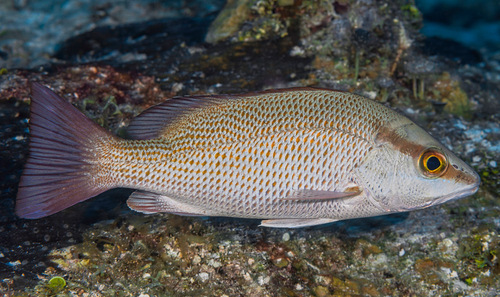
Gray Snapper
Lutjanus griseus
The Gray Snapper is the clever 'lawyer' of the mangroves, known for its keen intelligence and ability to thrive from deep reefs to suburban canals. A master of stealth, this resilient species is a cornerstone of the Western Atlantic's coastal ecosystems.
Quick Identification
Size
Typically 10-18 inches (25-45 cm), reaching up to 35 inches (89 cm); weight ranges from 1-10 lbs (0.5-4.5 kg), with a maximum of 20 lbs (9 kg).
Colors
Grayish-green, olive, or reddish-bronze on top with a pale belly; rows of small reddish-orange spots on the sides; dark diagonal stripe through the eye in juveniles.
Key Features
- Dark diagonal stripe through the eye (fades with age)
- No dark spot on the side (unlike Lane or Mutton snappers)
- Two prominent canine teeth in the upper jaw
- Tail fin is nearly straight or slightly indented
When You’ll See Them
Sightings on EverydayEarth
Jul 23, 2026
A diverse group of fish is active in the clear spring water. Several Sheepshead swim prominently in the foreground and midground, occasionally approaching the camera. Smaller Gray Snappers and streamlined Common Snook move through the lower portion of the frame and near the algae-covered structure at the top of the scene.
Jul 23, 2026
Several fish swim through the clear, sunlit water of Homosassa Springs. Sheepshead with their prominent black stripes are seen navigating near a floating, algae-covered log at the surface, while more slender Gray Snappers cruise in the middle of the water column. Fine particles of organic matter drift slowly with the gentle current.
Jul 23, 2026
A West Indian Manatee drifts calmly on the right side of the frame, showcasing its large, paddle-like tail. Several Sheepshead fish with their characteristic black stripes and a few Gray Snappers swim actively through the sunlit, clear spring water. The scene is peaceful with light filtering down from the surface where a wooden structure is visible.
Jul 23, 2026
Several species of fish are active in the crystal-clear water of the spring. A Sheepshead with vivid black stripes swims directly toward and past the camera lens. In the background, a Common Snook and several Gray Snappers glide near a submerged rectangular structure as sunlight filters through the surface.
Jul 12, 2026
In the crystal-clear water of Homosassa Springs, a West Indian manatee swims slowly near the surface, initially appearing to browse on floating vegetation. A large, diverse school of fish accompanies the manatee, including several Gray Snappers and a Sheepshead with its characteristic vertical stripes. A Common Snook is also visible, identified by its dark lateral line. The sunlight creates shimmering patterns on the sandy bottom and the manatee's back as it glides through the frame, eventually revealing its large paddle-shaped tail.
Jul 12, 2026
A West Indian manatee is seen swimming near the surface, feeding on floating lettuce. Below and around it, a large jubilee of fish including striped Sheepshead, Gray Snappers, and Common Snook swim through the clear spring water.
Geographic range
Where Does the Gray Snapper Live?
The Gray Snapper is a native resident of the Western Atlantic Ocean, with a geographic range that begins in the waters off Massachusetts and extends southward to the coast of Brazil. They are most densely concentrated in the Gulf of Mexico, the Caribbean Sea, and around the island chains of the Bahamas and Bermuda. While they are a tropical and subtropical species, their high tolerance for brackish and even fresh water allows them to inhabit estuaries and coastal rivers far from the open sea.
Basemap © OpenStreetMap contributors
Recorded on EverydayEarth
Behavior
In coastal suburban areas, they are frequently seen around dock pilings and seawalls, where they have learned to coexist with human activity. They are primarily nocturnal hunters, spending their days in the safety of mangroves or artificial structures and moving out into seagrass beds or open flats at night to forage. Their ability to thrive in varying salinities allows them to travel between the open ocean and freshwater springs.
EverydayEarth exclusive
Camera Tips
To successfully capture Gray Snappers on an AI camera, you will need a waterproof setup specifically designed for underwater use. If you live on a canal or have access to a private dock, mount your camera housing about 2 to 3 feet below the low-tide line. Position the lens so it faces a vertical structure, such as a dock piling or a mangrove root, as these fish rarely venture far from cover during the day. Angle the camera slightly upward toward the surface to take advantage of natural light filtering through the water.
Baiting is the most effective way to draw Gray Snappers into the frame and keep them there long enough for clear identification. Use a mesh bait bag filled with oily fish parts or crushed shrimp, and secure it roughly 3 to 5 feet from the lens. This creates a 'feeding station' that will attract the snapper's curiosity. Because these fish have incredible eyesight and are naturally wary of new objects, consider camouflaging your camera housing with artificial seagrass or tucking it into a shadowed area of the dock to make it less conspicuous.
Since Gray Snappers are most active during the crepuscular hours of dawn and dusk, ensure your camera is set to a high ISO or has an infrared (IR) night vision mode. Be aware that bright white lights can spook older, more experienced fish, so IR is often better for capturing natural behavior. Set your device to record short video clips (15-30 seconds) rather than still photos; the snapper's quick, darting movements are much easier to analyze in video format, and you'll be able to see their distinct social hierarchy in action.
Similar Species
Species that look similar or are commonly confused with Gray Snapper.
Schoolmaster Snapper
Features bright yellow fins and 8-10 faint pale vertical bars on its sides.
Cubera Snapper
Grows significantly larger (up to 100+ lbs) and has a more rounded, triangular tooth patch in the roof of the mouth.
Lane Snapper
Identified by its yellow horizontal stripes and a distinct black spot on the upper side below the dorsal fin.
Frequently Asked Questions
Record Gray Snapper at your habitat
Connect a camera to start building your own species record — AI identifies every visitor automatically.