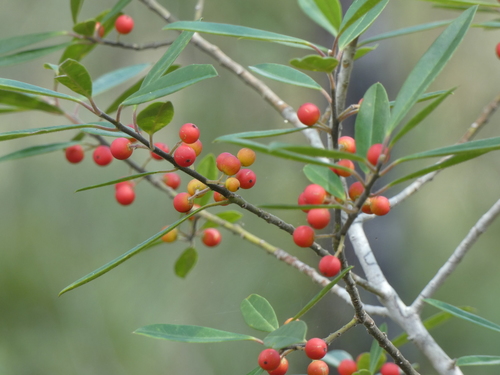
dahoon holly
Ilex cassine
A coastal classic with vibrant winter appeal, the dahoon holly is a lush evergreen that transforms damp backyard corners into bustling bird sanctuaries.
Quick Identification
Size
Height of 6-12 m (20-40 ft) with a spread of 3-6 m (10-20 ft)
Colors
Lustrous dark green leaves; bright red (occasionally yellow) berries; smooth, light gray bark
Key Features
- Oblong, leathery leaves usually lacking sharp spines
- Dense clusters of pea-sized bright red berries on female trees
- Smooth, pale gray bark often decorated with colorful lichens
- Small, four-lobed white flowers appearing in spring
When You’ll See Them
Geographic range
Where Does the dahoon holly Live?
Native to the humid coastal regions of North America, the dahoon holly is primarily found along the Atlantic and Gulf Coasts. Its range stretches from southeastern Virginia down through the entire Florida peninsula, extending west into Texas as far as the Colorado River. It also populates parts of the Caribbean, including the Bahamas, Cuba, and Puerto Rico, as well as coastal areas of Mexico.
Basemap © OpenStreetMap contributors
Behavior
In the wild, it follows a slow but steady growth pattern, often forming a dense, rounded canopy that provides excellent nesting sites and thermal cover for birds. It is highly adapted to 'wet feet,' naturally occurring in areas where other trees might drown. For homeowners, it is a low-maintenance beauty that bridges the gap between ornamental landscaping and high-value wildlife support.
EverydayEarth exclusive
Camera Tips
To capture the best action around a dahoon holly, focus your camera on the fruit-bearing female trees during the winter months. Position your camera on a nearby sturdy branch or a tripod about 5 to 7 feet off the ground, aiming at a clear cluster of red berries. This is a prime spot for 'set-and-forget' winter photography, as flocks of Cedar Waxwings, American Robins, and Northern Mockingbirds will frequently visit to forage. Use a fast shutter speed or high-frame-rate video to catch the quick movements of birds plucking berries.
During the spring, redirect your camera toward the small white flower clusters. While inconspicuous to humans, these are a magnet for pollinators. A camera with a good macro or close-focus capability can capture an array of native bees and butterflies. Because the dahoon holly often grows in damp areas, ensure your camera housing is rated for high humidity and check for lens fogging in the early morning hours.
Lighting is key for this species. The dark, glossy leaves can create high-contrast glares in direct overhead sun. Aim for a south-facing camera angle to get the best indirect light, or utilize the soft light of the 'golden hour' in the late afternoon, which makes the red berries glow against the dark foliage. If your camera has a time-lapse mode, consider setting it for a 24-hour cycle to see which nocturnal mammals, like opossums or raccoons, might visit the base of the tree to scavenge fallen fruit.
Similar Species
Species that look similar or are commonly confused with dahoon holly.
Frequently Asked Questions
Record dahoon holly at your habitat
Connect a camera to start building your own species record — AI identifies every visitor automatically.