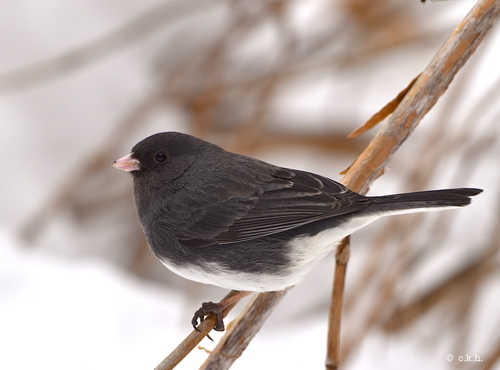
Dark-eyed Junco
Junco hyemalis
Often called the 'Snowbird,' the Dark-eyed Junco is a charming and social sparrow that signals the change of seasons. With their crisp white bellies and habit of hopping through winter gardens, they are a delight to discover on any backyard camera.
Quick Identification
Size
Length: 13-17 cm (5.1-6.7 in); Wingspan: 18-25 cm (7-9.8 in); Weight: 18-30 g (0.6-1.1 oz)
Colors
Varied by subspecies; typically dark gray or brown upperparts with a starkly contrasting white belly and white outer tail feathers.
Key Features
- Flash of white outer tail feathers in flight
- Dark gray or brown 'hooded' appearance
- Pinkish or pale conical bill
- Distinctive hopping and double-scratching foraging movement
When You’ll See Them
Sightings on EverydayEarth
Jul 2, 2026
A small Dark-eyed Junco is perched on a branch to the left of the large bald eagle nest. The bird remains stationary for several seconds, looking around, before flying out of the frame. The nest itself is currently empty, with wind visible rustling the surrounding oak leaves.
Jun 20, 2026
A Dark-eyed Junco is perched on the metal support arm of the feeder system. It remains alert for several seconds, observing its surroundings, before taking flight and leaving the frame.
May 26, 2026
A Dark-eyed Junco is perched on a wire suet feeder in the upper-left of the frame. It is actively pecking at the suet, occasionally shifting its position and flashing its white outer tail feathers as it balances.
Mar 30, 2026
A Black-capped Chickadee perches on the tube feeder to the right, briefly inspecting the seeds. Meanwhile, a Dark-eyed Junco lands on the main tray feeder, stays for a moment, and then quickly flies away toward the background.
Mar 29, 2026
A Black-capped Chickadee makes a quick visit to the feeder, followed by a Dark-eyed Junco that lands on the tray to forage for seeds. The junco stays for several seconds, hopping across the tray and scanning the ground before flying off.
Mar 27, 2026
A European Starling perches on the main feeder tray, showcasing its iridescent, speckled plumage. Shortly after, a Dark-eyed Junco lands on the tube feeder to the right, while another forages on the ground below the platform.
Geographic range
Where Does the Dark-eyed Junco Live?
The Dark-eyed Junco is a widespread native of North America, breeding across the boreal forests of Alaska and Canada and south through the high elevations of the Appalachian and Rocky Mountains. As winter approaches, these birds migrate across nearly the entire continental United States and parts of Northern Mexico, making them one of the most widely distributed birds on the continent during the colder months. While most are migratory, some populations in the Western US and the Appalachians remain year-round residents.
Basemap © OpenStreetMap contributors
Behavior
Dark-eyed Juncos are highly social birds, often found in winter flocks that maintain a clear social hierarchy. These groups, which can range from a few individuals to thirty or more, are often led by the most dominant males who arrived at the wintering grounds earliest. They are primarily ground-dwellers, preferring to hop across the forest floor or suburban lawns rather than perching high in trees. Watching a flock, you'll often see them 'double-scratching'—a quick hop forward followed by a backward kick with both feet to uncover seeds hidden under leaves or snow.
These birds are affectionately known as 'snowbirds' because their arrival in many parts of the United States coincides with the onset of winter weather. They are relatively bold around humans and are frequent visitors to backyard feeding stations, though they usually prefer to stay on the ground to clean up seeds dropped by other birds. Their flight is distinctive, characterized by a series of rapid wingbeats and a bright flash of white outer tail feathers that serves as a signal to other members of the flock.
EverydayEarth exclusive
Camera Tips
To capture the best footage of Dark-eyed Juncos, position your AI-powered camera very low to the ground, as this is where they spend nearly all their time. A mounting height of 6 to 12 inches is ideal. Aim the camera at a cleared patch of ground near a brush pile or hedge, as juncos like to stay close to cover so they can quickly dart away if a predator appears. Using a wide-angle setting is helpful to capture the social interactions of the entire flock.
Since juncos are 'gleaners,' they are best attracted by spreading white proso millet, hulled sunflower seeds, or finely cracked corn directly on the ground or on a low platform feeder. If you live in a snowy region, clearing a small 2-foot by 2-foot area of snow and placing seeds there will make your camera location the primary activity hub for the neighborhood birds. The contrast of their dark plumage against white snow can sometimes trick camera sensors; if your camera allows, slightly underexpose the shot to ensure the details in their white bellies aren't 'blown out.'
Pay attention to the early morning and late evening hours. Juncos are often the first birds to arrive at a feeding site at dawn and the last to leave at dusk. Ensure your camera is set to a high sensitivity during these low-light periods. If you're looking for unique behavior, set your camera to video mode to record their 'double-scratch' foraging technique, which is a signature move of the species that is much more interesting to watch than a static photo.
Similar Species
Species that look similar or are commonly confused with Dark-eyed Junco.
Frequently Asked Questions
Record Dark-eyed Junco at your habitat
Connect a camera to start building your own species record — AI identifies every visitor automatically.