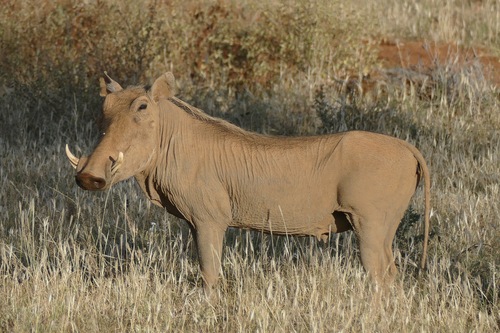
Desert Warthog
Phacochoerus aethiopicus
A specialist of the Horn of Africa's most rugged terrain, the Desert Warthog is a master of survival. Identifiable by its hooked ears and vertical tail, this resilient grazer brings a touch of prehistoric charm to the African scrubland.
Quick Identification
Size
Body length of 100–145 cm (3.3–4.8 ft) and weighing between 45–130 kg (100–285 lbs)
Colors
Brownish-grey skin with sparse dark bristles; features a distinct mane of longer hair along the spine and white whiskers on the cheeks
Key Features
- Distinctly hooked ear tips that fold backward
- Two pairs of facial warts, much larger in males
- Large, upward-curving canine tusks used for defense
- Tail held vertically upright when running
When You’ll See Them
Geographic range
Where Does the Desert Warthog Live?
The Desert Warthog is native to the Horn of Africa, with its core populations residing in central and eastern Kenya, Somalia, and the lowlands of Ethiopia. While a southern subspecies once lived in South Africa, it went extinct in the 19th century, leaving the extant populations exclusively in the arid northeastern regions of the continent. They are specialized residents of these dry landscapes and have not been introduced to other regions globally.
Basemap © OpenStreetMap contributors
Behavior
Desert Warthogs are highly social and intelligent mammals that live in small family groups known as 'sounders.' These groups usually consist of related females and their most recent offspring, while adult males tend to be more solitary, joining the groups primarily for mating. They are well-known for their unique habit of backing into burrows—often stolen from aardvarks—rear-first, keeping their formidable tusks pointed outward to deter predators like lions or leopards.
Unlike many other wild swine, the Desert Warthog is strictly diurnal, timing its activity to avoid the extreme heat of the midday sun. They are remarkably adapted to arid environments and can survive for long periods without standing water, obtaining moisture from the bulbs and tubers they dig up. When interacting with humans or perceived threats, they are generally shy and will flee with their tails held high like an antenna, though they can become extremely defensive if cornered.
EverydayEarth exclusive
Camera Tips
To capture the best footage of a Desert Warthog, focus your camera placement on 'infrastructure' rather than open ground. Look for active burrows, which are often large holes in the ground with cleared dirt at the entrance and fresh tracks nearby. Mount your camera approximately 24 to 30 inches (60-75 cm) off the ground and angle it slightly downward; this height is perfect for capturing their unique 'kneeling' posture as they graze or dig for roots.
Because they are strictly diurnal, you don't need to worry about heavy flash settings, but a fast trigger speed is essential. Desert Warthogs are surprisingly quick and often move in a brisk trot. Setting your camera to a 3-shot burst or a 20-second video clip will allow you to see the social dynamics of the sounder, particularly the way the piglets follow the mother in a single-file line.
Water is a massive draw for this species in their arid home range. If you are near a permanent or semi-permanent water hole, place your camera about 10-15 feet back from the water's edge. This provides a wide enough field of view to capture the entire group without scaring them off with the camera's presence. In the dry season, these locations are almost guaranteed to produce results during the mid-morning hours.
Similar Species
Species that look similar or are commonly confused with Desert Warthog.
Frequently Asked Questions
Record Desert Warthog at your habitat
Connect a camera to start building your own species record — AI identifies every visitor automatically.