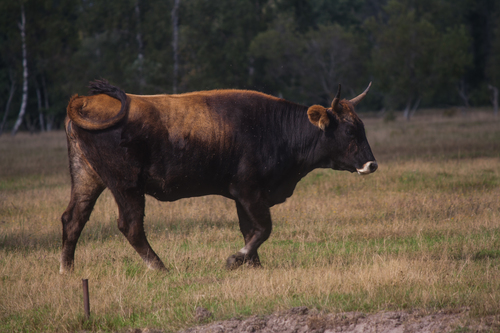
Domestic Cattle
Bos taurus
The Domestic Cow is a cornerstone of rural landscapes worldwide, known for its social intelligence and rhythmic grazing habits. From rolling hills to vast plains, these gentle giants are the ultimate subjects for capturing the peaceful essence of pastoral life.
Quick Identification
Size
Height: 1.2–1.5 m (4–5 ft) at the shoulder; Weight: 450–1,100 kg (1,000–2,400 lbs)
Colors
Highly variable by breed; common colors include solid black, white, red, and brown, or patterns like Holstein (black and white) and Hereford (red with white face).
Key Features
- Large, stocky body with a long tail ending in a hair tuft
- Cloven hooves and a wide, moist muzzle
- Prominent, laterally placed ears on a broad head
- Presence of horns in some breeds, though many are selectively bred to be polled
When You’ll See Them
Sightings on EverydayEarth
Jul 17, 2026
A dark-colored cow stands in the dry, sun-bleached grass of the woodland. It remains mostly stationary, occasionally twitching its ears and shifting its head while observing the area.
Jun 26, 2026
Under the glow of the infrared camera, a large white rhinoceros is seen resting calmly on the ground in the lower right of the frame. Nearby, a domestic cow stands and slowly moves around the clearing before also beginning to settle down. The scene is quiet, with both animals appearing relaxed in the nighttime woodland environment.
Jun 25, 2026
A small herd of black domestic cattle grazes in a lush green valley at the edge of a dense forest during the early morning hours.
Jun 19, 2026
A small herd of black cattle is seen grazing and resting in a vast green pasture during the early morning hours. Several calves are present, with some lying in the grass while others remain close to the adult cows.
Jun 17, 2026
A dark-colored cow stands stationary in a woodland clearing, partially framed by trees. It shifts its weight and turns its head slightly. A second individual is partially visible in the shadows to the left.
Jun 13, 2026
A night scene at a rhino enclosure where several animals are resting. A large White Rhino is positioned in the immediate foreground, occasionally twitching its ears and shifting its head. In the mid-ground, another rhino is seen lying down near the base of a tree. In the center background, two domestic cattle are resting quietly on the ground.
Geographic range
Where Does the Domestic Cattle Live?
Originally descended from the wild aurochs of Eurasia, domestic cattle are now found on every continent except Antarctica. They thrive across a massive global footprint, with the highest population densities found in India, Brazil, China, the United States, and Ethiopia. Because they are managed by humans, their range extends from tropical lowlands to high-altitude mountain pastures, making them one of the most widely distributed large mammals on Earth.
Basemap © OpenStreetMap contributors
Behavior
Domestic cattle are highly social herd animals that establish complex social hierarchies, often referred to as a 'pecking order.' They spend a significant portion of their day—up to eight hours—engaged in rumination, the process of regurgitating and re-chewing partially digested food (cud) to maximize nutrient extraction from tough plant fibers. This behavior is typically done while the animal is resting in a calm, shaded area.
While generally perceived as docile, cattle are naturally curious and intelligent creatures. They are capable of recognizing individual humans and other members of their herd for years. Their interactions with humans are usually peaceful, as they have been domesticated for nearly 10,000 years, but they can become protective or aggressive if they feel their calves are threatened or if their personal space is invaded by unfamiliar triggers.
EverydayEarth exclusive
Camera Tips
Capturing domestic cattle on a trail camera requires a setup that can withstand their immense physical power and natural curiosity. These animals love to rub against vertical objects to scratch an itch; if you mount your camera on a standard wooden post, there is a high probability they will knock it out of alignment or break the mount. We recommend using a heavy-duty T-post with a protective steel 'bear box' or security housing. This not only protects the camera from physical impact but also prevents curious cows from licking the lens, which can leave a blurry residue of saliva.
For the best framing, position your camera at chest height—roughly 3 to 4 feet off the ground. This angle captures the impressive scale of the animal and its facial features as it grazes. If you are monitoring a large pasture, place your camera near 'bottleneck' points such as gates, water troughs, or under large shade trees where the herd gathers to ruminate during the heat of the day. Salt licks are also an excellent attractant that will keep them in front of the lens for extended periods.
Because cattle are large and move relatively slowly while grazing, you can afford to use a slightly longer trigger interval to avoid filling your SD card with thousands of identical shots of the same herd. However, use a fast shutter speed (if your camera allows) or high-quality video mode to capture the subtle social interactions, such as social grooming or 'allogrooming,' where two cows lick each other to reinforce social bonds. If your camera has a 'time-lapse' mode, this is a fantastic way to capture the movement of the entire herd across a field over the course of a day.
Similar Species
Species that look similar or are commonly confused with Domestic Cattle.
Frequently Asked Questions
Record Domestic Cattle at your habitat
Connect a camera to start building your own species record — AI identifies every visitor automatically.