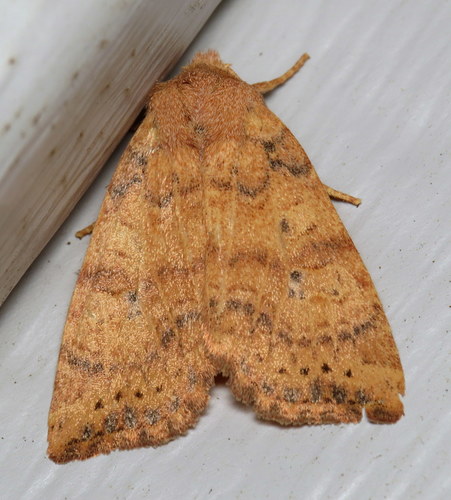
Dotted Sallow
Anathix ralla
A delicate, straw-colored gem of the late-summer garden, the Dotted Sallow is a master of camouflage. This nocturnal visitor is a sign that autumn is on its way, appearing just as the leaves begin to turn.
Quick Identification
Size
Wingspan of 28–35 mm (1.1–1.4 inches)
Colors
Pale straw-yellow to light tan forewings with fine dark brown or blackish dots; hindwings are typically a lighter, smoky white or cream color.
Key Features
- Pale yellow or buff base color
- Forewing spots (orbicular and reniform) outlined by small dark dots
- Jagged, faint transverse lines across the wings
- Relatively small and slender body compared to other Noctuids
When You’ll See Them
Geographic range
Where Does the Dotted Sallow Live?
The Dotted Sallow is native to North America, where it is found across a wide swath of the eastern and central regions. Its core range extends from the Atlantic coast of the United States and Canada, reaching westward through the Great Lakes and into the eastern edge of the Great Plains. While most common in the Northeast and Midwest, it can be found as far south as the Mid-Atlantic states, thriving in areas where its larval host plants are abundant.
Basemap © OpenStreetMap contributors
Behavior
The Dotted Sallow is a nocturnal moth that is most active during the transition from late summer into early autumn. Unlike many other moths that are active throughout the warmer months, this species has a relatively narrow flight window, making it a special find for backyard observers. During the day, it rests with its wings folded flat over its back, using its pale coloration to blend in perfectly with dried leaves, grasses, or woody debris.
In the evening, they take to the air to find mates and food sources. While they are readily attracted to artificial light sources, they are also highly motivated by scent. They are frequent visitors to 'bait' stations and are often seen feeding on fermenting fruit or the sap of trees that have been damaged by woodpeckers or weather. They are generally docile and will remain still for long periods while feeding, providing excellent opportunities for observation.
EverydayEarth exclusive
Camera Tips
To capture the Dotted Sallow on your AI camera, you will need to focus on its two primary attractants: light and fermented sweets. Because this moth is small, the most successful setups involve a 'moth sheet'—a white fabric hung vertically with a UV or mercury vapor light shining on it. Position your camera about 12 to 18 inches from the sheet. This provides a clean, high-contrast background that makes it easier for AI algorithms to pick up the fine dotted patterns on the wings.
A second, highly effective strategy is 'sugaring.' Mix overripe bananas, brown sugar, and a splash of beer or molasses, allowing the mixture to ferment in the sun for a day. Paint this onto a tree trunk at eye level and mount your camera nearby. The Dotted Sallow is particularly fond of these sweet, fermented scents and will often settle on the bait for several minutes, allowing for high-quality, still images that are much clearer than those taken in flight.
Since this species only flies in the late summer and early fall, timing is everything. Make sure your camera is deployed and active starting in mid-August. They are most active on humid, overcast nights when the temperature stays above 60°F (15°C). If your camera allows for it, use a macro lens or a close-focus setting, as the intricate 'dots' that give this moth its name are its most defining characteristic but can be missed with a standard wide-angle trail cam lens.
Similar Species
Species that look similar or are commonly confused with Dotted Sallow.
Frequently Asked Questions
Record Dotted Sallow at your habitat
Connect a camera to start building your own species record — AI identifies every visitor automatically.