Dugong
Dugong dugon
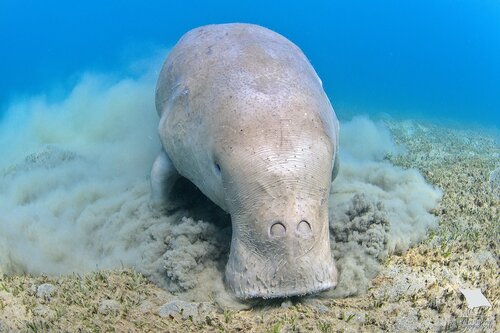
The gentle 'sea cow' of the Indo-Pacific, the Dugong is a master of the seagrass meadows. Known for its whale-like tail and shy nature, this marine marvel is a symbol of coastal health and mystery.
Quick Identification
Size
Length 2.4 to 3 metres (7.9 to 9.8 feet); weight 250 to 420 kg (550 to 925 lbs)
Colors
Slate grey to brownish-grey skin; lighter, cream-colored underside; older individuals may have extensive scarring or white patches
Key Features
- Fluked tail similar to a dolphin or whale
- Downward-facing, horseshoe-shaped snout with sensitive bristles
- Paddle-like flippers without nails
- Small eyes and no external ear flaps
When You’ll See Them
Geographic range
Where Does the Dugong Live?
The dugong is native to the warm coastal waters of the Indo-West Pacific region. Its vast range extends across more than 40 countries, with the largest and most significant populations found in the waters of northern Australia, between Shark Bay and Moreton Bay. Beyond Australia, they are found throughout Southeast Asia, the Red Sea, the Persian Gulf, and along the eastern coastline of Africa from Egypt down to Mozambique.
Basemap © OpenStreetMap contributors
Behavior
The dugong is a peaceful and slow-moving marine mammal often referred to as a 'sea cow' due to its grazing lifestyle. They spend the vast majority of their time feeding on underwater seagrass meadows, using their powerful, bristled snouts to root up plants and even shake off sediment before eating. While they are capable of holding their breath for several minutes, they typically surface every few minutes to breathe through nostrils located at the top of their head.
Socially, dugongs are somewhat solitary but are frequently seen in pairs, particularly mothers with their calves. Large herds of several hundred have been recorded in the past, though these are now rare due to population declines. They communicate through a series of chirps, whistles, and barks that travel through the water, though they are generally shy and will quickly swim away if they perceive a threat from boats or divers.
EverydayEarth exclusive
Camera Tips
Capturing a dugong on camera is a significant achievement for any coastal enthusiast. Because they are entirely aquatic, your best bet is an underwater setup. If you have a backyard jetty or a private beach in a known dugong area, consider mounting a camera with a high-quality underwater housing to a weighted tripod or a permanent PVC pole. Position the lens 1 to 2 metres above the sandy bottom, angled slightly downward toward a seagrass patch. Since dugongs leave visible 'feeding trails' through the grass, placing your camera near these paths is the most effective way to ensure a sighting.
Timing is critical. Dugongs are heavily influenced by the tide; they often wait for high tide to move into shallower areas to feed on grass that is inaccessible at low tide. Set your camera to record high-resolution video during the two hours before and after high tide. Use a wide-angle lens (120 degrees or more) because dugongs are large animals, and visibility in coastal waters can be limited. A wider lens ensures you capture the whole body even if the water is slightly turbid.
In terms of lighting, daylight is your friend. The best footage usually occurs between 10 AM and 2 PM when the sun is directly overhead, providing maximum light penetration into the water. If you are using a camera with motion-sensing AI, ensure it is tuned to detect large, slow-moving objects. Standard motion sensors can sometimes be fooled by swaying seagrass or floating debris, so a camera with a 'pre-record' or 'buffer' feature is ideal to capture the moment they first drift into frame.
Finally, keep your equipment clean. In tropical waters, algae and barnacles can grow on your camera housing lens within days. If your camera is a permanent fixture, you will need to wipe the lens cover every 48 to 72 hours to maintain clarity. Do not use artificial white lights at night, as this can startle the animals and alter their natural behavior; instead, rely on the camera's low-light sensor or subtle infrared if the depth allows for it.
Similar Species
Species that look similar or are commonly confused with Dugong.
Frequently Asked Questions
Record Dugong at your habitat
Connect a camera to start building your own species record — AI identifies every visitor automatically.