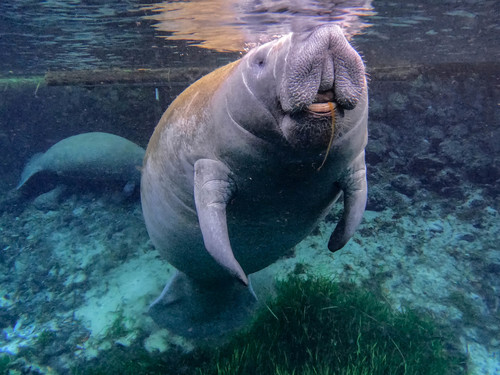
West Indian Manatee
Trichechus manatus
The West Indian Manatee is a gentle aquatic giant, often called the 'sea cow' for its peaceful grazing habits. Found in the warm coastal and inland waters of the Americas, these curious mammals are a testament to the beauty of our underwater ecosystems.
Quick Identification
Size
Typically 2.7–3.5 meters (8.9–11.5 feet) long and weighing 200–600 kg (440–1,300 lbs), though some individuals exceed 1,000 kg.
Colors
Uniformly grayish to brownish-gray, often appearing greener due to algae growth on the skin or lighter due to barnacle attachment.
Key Features
- Large, flat, paddle-shaped tail used for propulsion
- Flexible, prehensile upper lip covered in thick sensory whiskers (vibrissae)
- Small, widely spaced eyes and no external ear flaps
- Thick, wrinkled skin with sparse hair across the body
When You’ll See Them
Sightings on EverydayEarth
Aug 1, 2026
Three West Indian Manatees, including a mother and calf pair, glide slowly through the clear blue waters of Silver Springs. A massive school of small silver fish surrounds them, swirling in coordinated patterns and darting out of the path of the larger marine mammals as they move through the center of the frame.
Jul 30, 2026
An adult West Indian Manatee and its calf swim slowly through the crystal-clear water. A large number of small fish are also visible throughout the scene, particularly near the submerged vegetation where they dart in and out of the light.
Jul 30, 2026
An adult West Indian Manatee and a smaller juvenile swim slowly through the crystal-clear spring water. They glide peacefully over the vegetated riverbed while numerous small fish dart around them, catching the sunlight filtering from the surface.
Jul 30, 2026
A pair of manatees, likely a mother and calf, swim gracefully through the clear spring water. They are accompanied by a large, dense school of fish that swirls around them as they move slowly through the aquatic vegetation.
Jul 28, 2026
A large West Indian Manatee floats calmly in the clear spring water near a surface-level feeding station containing leafy greens. Several fish, including striped Sheepshead, swim actively around the manatee and the feeding frame. The manatee appears to be resting or slowly maneuvering toward the food.
Jul 28, 2026
A West Indian Manatee floats near the surface of the murky green water. It is positioned next to a black PVC floating frame filled with lettuce, a common supplemental feeding method. The manatee remains relatively still, with its large, rounded back and broad tail visible just beneath the surface, occasionally drifting slightly with the current.
Behavior
West Indian Manatees are gentle, slow-moving giants that spend the majority of their time eating, resting, and traveling. Despite their size, they are incredibly graceful in the water, typically cruising at about 5 miles per hour. While they are often solitary, they are not strictly territorial and are frequently seen in small, informal groups, especially during the winter when they huddle together for warmth near natural springs or power plant discharge pipes.
These mammals are highly curious and use their sensitive facial whiskers to explore their environment and find food. They must surface to breathe air every three to five minutes when active, though they can hold their breath for up to 20 minutes when resting. While generally shy, they are known to occasionally investigate docks or slow-moving boats, though human interaction should always be kept passive to avoid disturbing their natural behaviors.
EverydayEarth exclusive
Camera Tips
Capturing the West Indian Manatee requires a specialized approach since they are almost entirely aquatic. If you have a backyard dock in a coastal or canal-front area, the best setup is a high-resolution underwater 'action' camera or a specialized aquatic trail camera mounted to a dock piling. Position the camera about 2-3 feet below the low-tide line, angled slightly upward toward the surface. This allows you to capture the manatee's face and unique 'lip-walking' feeding behavior as they graze on algae or vegetation growing on your dock.
For those using standard trail cameras above water, placement is key. Mount your camera on a sturdy post or dock railing overlooking a slow-moving section of water. Look for 'manatee boils'—circular swirls on the water's surface created by their tails—which indicate a high-traffic area. Use a polarising filter over your lens if possible to cut through the water's surface glare, allowing the camera to trigger on the dark shape of the manatee beneath the surface rather than just the ripples.
Time your captures for the early morning or late afternoon when the sun is at an angle, as midday overhead sun can create too much reflection for clear images. In winter, focus your efforts on freshwater canals or areas near warm-water outlets. Avoid using bright artificial lights at night, as this can startle the animals; instead, rely on cameras with high-quality 'no-glow' infrared sensors. Remember that manatees are a protected species, so your camera setup must be entirely passive—never submerge a camera in a way that obstructs their path or attempt to lure them with food or freshwater hoses, which is illegal in many jurisdictions.
Similar Species
Species that look similar or are commonly confused with West Indian Manatee.
Dugong
The dugong has a fluked, whale-like tail and a more downward-turned snout for bottom feeding.
Amazonian Manatee
Smaller in size, strictly freshwater, and often features a distinct bright white or pink patch on the chest.
African Manatee
Very similar in appearance but found only in the coastal waters and rivers of Western Africa; it has a more prominent snout.
Frequently Asked Questions
Record West Indian Manatee at your habitat
Connect a camera to start building your own species record — AI identifies every visitor automatically.