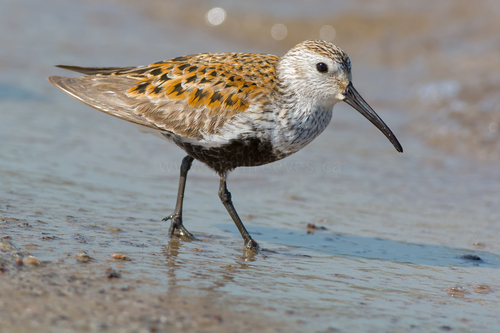
Dunlin
Calidris alpina
Meet the 'sewing machine' of the shore. The Dunlin is a master of migration, famous for its synchronized aerial displays and its unique drooping bill that probes the world's mudflats with incredible precision.
Quick Identification
Size
Length: 17–21 cm (6.7–8.3 in); Wingspan: 32–36 cm (13–14 in); Weight: 40–85 g (1.4–3.0 oz)
Colors
Breeding adults show a striking black belly patch and reddish-brown back; non-breeding plumage is a uniform dull gray-brown above and white below.
Key Features
- Long black bill with a distinctive downward droop at the tip
- Prominent black belly patch in breeding plumage
- Medium-sized wader with a hunched, short-necked profile
- Rapid 'sewing machine' bill movement while foraging
When You’ll See Them
Geographic range
Where Does the Dunlin Live?
The Dunlin is a truly global traveler with a circumpolar breeding range across the high Arctic of North America, Europe, and Asia. As the seasons change, these birds embark on long-distance migrations to winter along the temperate and subtropical coastlines of the Northern Hemisphere. They are commonly found along the Atlantic and Pacific coasts of the United States and Mexico, the shores of the Mediterranean, and throughout the coastal regions of East Asia.
Basemap © OpenStreetMap contributors
Behavior
Dunlins are highly gregarious shorebirds, known for forming massive, tightly packed flocks during the winter months. In flight, these flocks move with incredible coordination, twisting and turning in unison—a defensive tactic against aerial predators like falcons. On the ground, they are famously industrious, often appearing less skittish than other shorebirds. They spend hours huddled together during high tide, waiting for the water to recede so they can begin feeding again.
Their foraging behavior is their most recognizable trait; they move across mudflats with a characteristic hunched posture, rapidly probing their bills into the soft substrate. This 'sewing machine' motion allows them to locate prey by touch using sensitive nerve endings in their bill tips. While they are usually quiet during the winter, their breeding season on the tundra involves complex flight songs and trilling calls used to establish territories.
EverydayEarth exclusive
Camera Tips
To capture high-quality footage of a Dunlin, camera placement must be dictated by the tides. If you have access to a coastal property or a muddy shoreline, set your AI-powered camera on a low-profile mount just a few inches above the ground. Angle the lens slightly upward to catch the bird's underside and its distinctive drooping bill. Dunlins are small, so getting the camera as low as possible creates a more intimate, professional-looking perspective that makes the bird appear larger and more engaging.
Unlike backyard songbirds, Dunlins won't come to a seed feeder. Instead, look for 'hotspots' in the mud where they have recently fed—these are often marked by hundreds of tiny probe holes. Placing your camera near these areas or beside shallow pools of water left behind by the receding tide increases your chances of capturing their intense foraging behavior. These birds are creatures of habit and will often return to the same patch of mud as long as the food supply lasts.
Because Dunlin movement is so fast, particularly their 'sewing machine' probing, use a camera with a high frame rate or a fast trigger speed. 4K video at 60fps is ideal for slowing down their movements in post-production to see exactly what they are pulling from the mud. Lighting is best during the 'golden hours' of early morning or late afternoon, which highlights the subtle textures in their gray-brown winter feathers. Always ensure your camera housing is salt-spray resistant if you are operating in a coastal environment.
Similar Species
Species that look similar or are commonly confused with Dunlin.
Western Sandpiper
Smaller with a straighter, shorter bill and lacks the black belly patch in breeding plumage.
Sanderling
Paler overall with a straight bill; usually found running on sandy wave-washed beaches rather than muddy estuaries.
Curlew Sandpiper
Features a more evenly curved, longer bill and a bright white rump visible during flight.
Frequently Asked Questions
Record Dunlin at your habitat
Connect a camera to start building your own species record — AI identifies every visitor automatically.