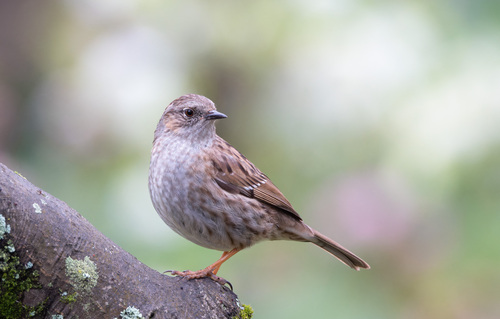
Dunnock
Prunella modularis
The Dunnock is the 'quiet neighbor' of the bird world—a subtle, ground-dwelling accentor with a lead-grey breast and a secret, complex social life. Often mistaken for a sparrow, this delightful bird brings life to the low hedges and shadowed corners of your garden.
Quick Identification
Size
Length 14.5 cm (5.7 in); Wingspan 19–21 cm (7.5–8.3 in); Weight 16–25 g (0.6–0.9 oz)
Colors
Lead-grey head and breast; warm brown back with black streaks; reddish-brown legs; dark, thin bill.
Key Features
- Fine, needle-like bill for insect eating
- Lead-grey throat and chest
- Streaky brown wings and back similar to a sparrow
- Low-to-the-ground shuffling gait with frequent wing-flicking
When You’ll See Them
Geographic range
Where Does the Dunnock Live?
Native to the temperate expanse of Europe and stretching across the Palearctic into Asian Russia, the Dunnock is one of the most common birds across the Western continent. It is a resident species in the United Kingdom and much of Western Europe, while populations in the colder north and east are often migratory. Beyond its native range, the Dunnock was successfully introduced to New Zealand in the late 19th century, where it has since become a widespread and familiar sight across both the North and South Islands.
Basemap © OpenStreetMap contributors
Behavior
The Dunnock is a quiet and unassuming bird, often observed creeping along the ground near the base of hedges or thickets with a distinctive 'shuffling' gait. Unlike the bold House Sparrow, the Dunnock is relatively solitary outside of the breeding season and tends to stay close to cover, retreating into the shadows at the slightest disturbance. You will often see them flicking their wings nervously as they forage, a behavior that persists even when they aren't in flight.
In the spring, their behavior becomes much more dramatic. They are famous among ornithologists for their complex mating systems, which can include monogamy, polyandry (one female with two males), and polygynandry. This social complexity leads to high-energy chases through garden shrubbery and a beautiful, thin, warbling song delivered from the top of a bush to defend their territory. Despite their shy nature, they adapt well to human presence and are frequent visitors to quiet corners of suburban gardens.
EverydayEarth exclusive
Camera Tips
To capture high-quality footage of a Dunnock, ground-level placement is essential. These birds rarely visit hanging feeders, preferring to forage for 'scraps' that have fallen to the floor. Position your camera about 6 to 12 inches off the ground, angled slightly downward toward a clear patch of earth or short grass immediately adjacent to a dense hedge or shrub. They feel safest when cover is only a few inches away, so avoid placing cameras in the middle of open lawns.
Because Dunnocks have a thin, insect-eating bill, they can be picky about standard birdseed. To lure them in front of your lens, use finely crushed suet pellets, mealworms, or very small seeds like nyjer or crumbled sunflower hearts. Standard large sunflower seeds are often too big for them to handle easily. Scattering these small treats in the shadows under a bush will almost certainly attract the local Dunnock while potentially keeping bolder, larger birds at bay.
Set your camera to a high sensitivity or a fast trigger speed. Dunnocks are known for their constant 'wing-flicking' and jerky movements; a slow shutter or long trigger delay will often result in a blurry tail or an empty frame as the bird hops out of view. If your camera has a 'Photo + Video' mode, use it—the still photo will capture their intricate grey and brown markings, while the video will showcase their unique shuffling movement.
Lighting can be a challenge since these birds prefer the shade. If possible, position your camera so it faces North to avoid lens flare, and look for 'dappled' light conditions. In winter, they are much bolder and will spend more time in the open to find food, making the colder months the best time for clear, bright captures. During the spring, listen for their persistent, squeaky song—if you hear it, they are nesting nearby and will be repeatedly using the same flight paths to gather insects.
Similar Species
Species that look similar or are commonly confused with Dunnock.
House Sparrow
The House Sparrow has a much thicker, conical bill and lacks the Dunnock's uniform lead-grey face and breast.
European Robin (Juvenile)
Juvenile Robins are also streaky and brown, but they have a more upright posture and lack the Dunnock's grey tones.
Alpine Accentor
A close relative, but much larger with distinct white spotting on the throat and reddish-orange flanks; found at much higher altitudes.
Frequently Asked Questions
Record Dunnock at your habitat
Connect a camera to start building your own species record — AI identifies every visitor automatically.