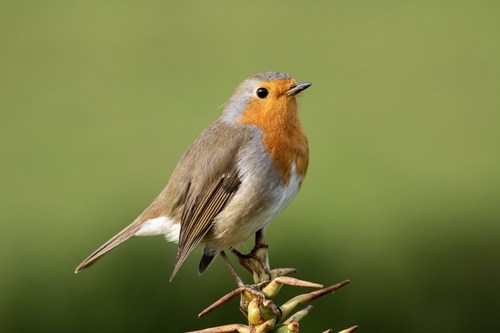
European Robin
Erithacus rubecula
With its iconic red breast and soulful song, the European Robin is the quintessential garden companion. Famous for its bold personality and 'gardener's friend' reputation, this tiny bird is a favorite for backyard observers across Europe.
Quick Identification
Size
Length: 12.5–14 cm (5–5.5 in); Wingspan: 20–22 cm (8–8.5 in); Weight: 16–22 g (0.6–0.8 oz)
Colors
Distinctive orange-red breast and face bordered by a narrow bluish-grey band. Upperparts are olive-brown and the belly is off-white. Males and females are identical in plumage.
Key Features
- Bright orange-red breast and forehead
- Large, dark 'soulful' eyes
- Olive-brown wings and tail
- Relatively long, spindly legs
- Upright, inquisitive posture
When You’ll See Them
Geographic range
Where Does the European Robin Live?
The European Robin is native to the Palearctic region, spanning across the entire European continent from the British Isles to the Ural Mountains. Its range extends south into North Africa and the Middle East, with populations also found in Western Siberia and Turkey. While they are permanent residents in the temperate climates of Western Europe, populations in Scandinavia and Russia migrate south to the Mediterranean to escape the harshest winter weather.
Basemap © OpenStreetMap contributors
Behavior
The European Robin is one of the most charismatic and territorial garden birds in the world. Unlike many species that only defend territory during the breeding season, robins are famous for maintaining their patches year-round. Both males and females sing throughout the winter to proclaim their territory, making them one of the few birds heard during the darkest months. They are remarkably bold around humans, often following gardeners to snatch up earthworms and grubs disturbed by digging—a behavior evolved from following large mammals like wild boar through the forest.
While they appear sweet and friendly to us, they are fierce defenders of their space. Intruding robins are often met with aggressive posturing—tilting their red breasts upward—and occasionally physical combat that can be surprisingly intense for such small creatures. Despite this fiery nature, they are highly socialized to suburban life, becoming quite tame and even learning to eat from a human's hand in consistent environments.
EverydayEarth exclusive
Camera Tips
To capture the European Robin on your backyard camera, focus on their ground-level foraging habits. Since they are active searchers that hop through leaf litter, place your camera low to the ground—about 6 to 12 inches high. Angle the lens slightly upward or keep it level with a clear patch of soil, a low-profile bird bath, or a flat stone. Robins are highly attracted to water, especially for bathing, so a shallow dish is a perfect focal point for high-action shots.
Baiting is highly effective for these curious birds. Mealworms (live or dried) are their 'gold standard' treat and will almost guarantee a close-up encounter. You can also use suet pellets or crushed sunflower hearts. Try placing the food near a 'perch' like a garden fork handle, a fence post, or a specific branch; robins love to scan the ground from a slightly elevated position before jumping down to eat, providing a great opportunity for still-shot captures.
Because robins are active very early in the morning and late into the twilight—often being the first and last birds at the feeder—ensure your camera has good low-light sensitivity or a fast trigger speed to avoid motion blur. During the winter, they become much bolder as natural food becomes scarce, making the colder months the best time to get high-quality, close-range footage. If your camera has a 'macro' focus or adjustable focal range, set it for 1-2 meters, as robins will often hop right up to the lens to investigate the device.
Similar Species
Species that look similar or are commonly confused with European Robin.
American Robin
Much larger thrush; has a grey back and orange belly, but lacks the orange face of the European species.
Dunnock
Similar size and ground-hopping behavior, but lacks the red breast, having a streaky brown back and grey head instead.
Common Nightingale
Uniformly brown plumage with a reddish tail; lacks the red breast and is much more secretive and shy.
Frequently Asked Questions
Record European Robin at your habitat
Connect a camera to start building your own species record — AI identifies every visitor automatically.