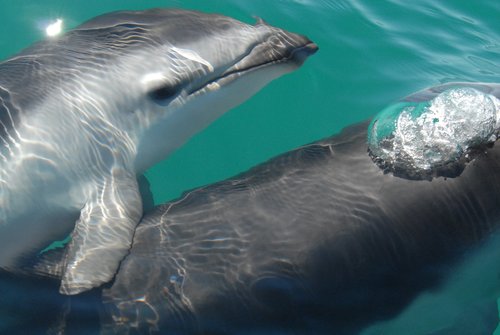
Dusky Dolphin
Aethalodelphis obscurus
The Dusky Dolphin is the Southern Hemisphere's premier acrobat, known for spectacular leaps and a curious, social nature. Found in cool coastal currents, this tri-colored marvel is a favorite for wildlife watchers from New Zealand to South America.
Quick Identification
Size
1.6–2.1 meters (5.2–6.9 feet) in length; 60–100 kg (132–220 lbs) in weight
Colors
Distinctive tri-color pattern with a dark grey to black back, light grey flanks, and a white underside; two-toned dorsal fin (darker on the leading edge, lighter on the trailing edge).
Key Features
- Short, blunted beak with no distinct forehead crease
- Highly curved, two-toned dorsal fin
- Two pale grey 'suspenders' streaks sweeping forward from the tail
- Stocky, compact body build
- Dark 'mask' pattern around the eyes
When You’ll See Them
Geographic range
Where Does the Dusky Dolphin Live?
Native to the Southern Hemisphere, the Dusky Dolphin is found in a patchy, circumpolar distribution. Its primary populations are concentrated in the coastal waters of South America, southwestern Africa, and New Zealand, with significant sightings also recorded around various sub-antarctic islands and southern Australia. You will most likely encounter them in the nutrient-rich currents of the Humboldt Current off Peru and Chile, the Benguela Current off Namibia and South Africa, and the deep coastal trenches off New Zealand's South Island.
Basemap © OpenStreetMap contributors
Behavior
The Dusky Dolphin is widely regarded as one of the most acrobatic and social cetaceans in the world. They are famous for their high-energy aerial displays, which include clean head-first leaps, acrobatic flips, and noisy 'side-slaps.' These behaviors aren't just for show; they serve as critical communication signals within the pod, often used to coordinate movements or signal the discovery of a dense school of fish.
These dolphins are highly gregarious, typically traveling in pods of 20 to several hundred individuals. Their social structure is fluid, with groups merging into 'super-pods' during large-scale feeding events. To humans, they are exceptionally curious and are well-known for 'bow-riding'—hitching a ride on the pressure waves created by moving boats—and even interacting playfully with swimmers in regions like Kaikoura, New Zealand.
EverydayEarth exclusive
Camera Tips
Capturing the Dusky Dolphin requires a specialized approach, as these are marine mammals. If you live on a coastal property or have pier access, the best camera placement is high above the water line, angled at roughly 30 to 45 degrees toward the sea. Use a waterproof housing or a trail camera with a high-quality glass lens to combat salt spray. For the best results, aim your camera toward areas of 'boiling' water, which often indicates a feeding frenzy where dolphins will be most active.
Because Dusky Dolphins are incredibly fast and acrobatic, your camera settings are the most important factor. Set your device to a high frame rate (at least 60fps for video) or use a rapid 'burst mode' for stills. A fast shutter speed—at least 1/1000th of a second—is essential to freeze the action of a leap and capture the fine spray of water. If your camera allows for it, use a circular polarizing filter to cut through surface glare and see the dolphins just beneath the water's surface.
While you cannot bait dolphins in the traditional sense, you can time your camera activity to match the presence of their prey. Large flocks of diving gannets or gulls are a 'natural lure' that signal dolphins are nearby. Early morning light provides the best contrast for their tri-colored bodies, but if you are using an AI-powered camera with motion detection, ensure the sensitivity is tuned to ignore wave motion while still triggering for large, fast-moving shapes.
Similar Species
Species that look similar or are commonly confused with Dusky Dolphin.
Pacific White-sided Dolphin
Very closely related but found exclusively in the Northern Hemisphere; has a more robust dorsal fin.
Short-beaked Common Dolphin
Features a distinct yellow/tan hourglass pattern on its flanks and a much longer, narrower beak.
Hourglass Dolphin
Found in colder, Antarctic waters with a much more stark, high-contrast black and white pattern.
Frequently Asked Questions
Record Dusky Dolphin at your habitat
Connect a camera to start building your own species record — AI identifies every visitor automatically.