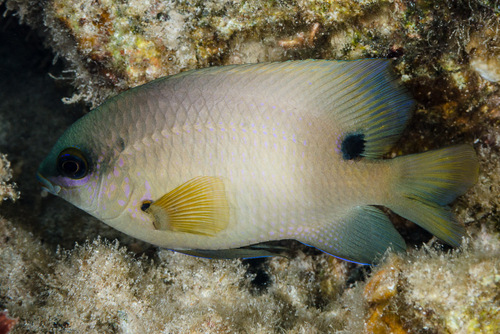
Dusky Gregory
Stegastes nigricans
Meet the reef's most dedicated gardener. The Dusky Gregory is a small fish with a big personality, famous for growing its own food and fiercely defending its territory against all comers.
Quick Identification
Size
Typically 12 to 15 cm (4.7 to 5.9 inches) in length
Colors
Adults are a uniform dark chocolate brown or sooty black. Some individuals display a faint purplish hue on the scales. Fins are usually the same dark color as the body.
Key Features
- Distinctive dark spot at the base of the last dorsal rays
- Steep, blunt head profile
- Large, protective scales with dark edges
- Small mouth with specialized teeth for grazing
When You’ll See Them
Geographic range
Where Does the Dusky Gregory Live?
The Dusky Gregory is widely distributed across the warm waters of the Indo-Pacific. Its range begins along the East African coast and the Red Sea, stretching eastward across the Indian Ocean to the tropical islands of the Central Pacific, including the Line and Society Islands. In the Western Pacific, they are found as far north as southern Japan and as far south as the Great Barrier Reef in Australia, thriving in almost any tropical reef environment within this massive corridor.
Basemap © OpenStreetMap contributors
Behavior
The Dusky Gregory is best known as the "farmer of the reef." Unlike most fish that roam for food, this species claims a specific patch of coral or rock and intensively manages it. They are famous for their "monoculture" farming, where they selectively weed out unpalatable algae species to allow their preferred filamentous red algae to grow. This behavior creates a lush, green-to-red carpet that is easily distinguishable from the surrounding barren reef.
These fish are intensely territorial and surprisingly aggressive for their small size. They will fearlessly charge at any creature that enters their territory, including much larger fish, sea urchins, and even human divers. Their social structure is mostly solitary, with each individual defending its own food source, though they may interact briefly during the spawning season when males guard egg nests.
EverydayEarth exclusive
Camera Tips
To capture the Dusky Gregory, you need to identify their 'garden' first. Look for a patch of reef that looks suspiciously well-kept—usually a fuzzy, brownish-red patch of algae on a dead coral branch. This is the fish's territory. Position your underwater camera or action camera on a weighted tripod or a nearby rock about 12 to 18 inches away from the center of the garden. Because these fish are territorial, they will likely approach the camera to inspect it almost immediately after you leave the area.
Lighting is crucial for these dark-colored fish. Since they live in shallow water, try to film during the middle of the day when the sun is directly overhead to penetrate the water column. If your camera has a high-speed trigger or AI detection, set it to look for fast movement; these fish are quick, darting in and out of crevices to chase away intruders. Using a wide-angle lens is recommended to capture both the fish and its unique farming environment.
Since the Dusky Gregory is a resident species, you can set up long-term monitoring stations if you have a waterproof housing with a power tether. Avoid using bait, as this will disrupt their natural farming behavior and attract larger predators that might scare the Gregory away or damage your equipment. Instead, rely on their natural instinct to defend their home; they are often more than happy to perform for the camera simply because it is an 'intruder' in their space.
Maintain your equipment by checking for salt buildup on the lens port, which can blur the image. In a 'backyard' reef setting, ensure your camera is securely anchored, as the surge in shallow water can be surprisingly strong. If you are using an AI-powered system, train it to recognize the specific dark, oval silhouette of the damselfish to filter out passing schools of less interesting species.
Similar Species
Species that look similar or are commonly confused with Dusky Gregory.
Frequently Asked Questions
Record Dusky Gregory at your habitat
Connect a camera to start building your own species record — AI identifies every visitor automatically.