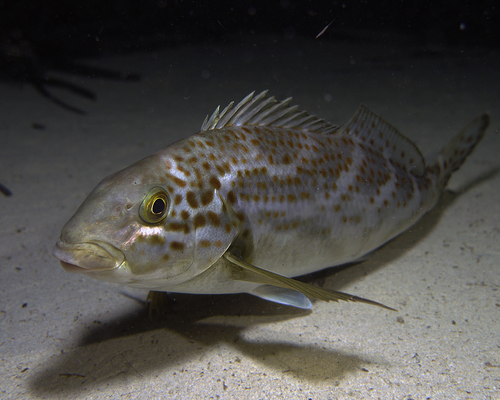
Dusky Morwong
Dactylophora nigricans
A stoic giant of the Australian kelp forests and seagrass meadows, the Dusky Morwong is a master of the bottom-dwelling lifestyle. Known for its impressive size and thick-lipped appearance, this solitary fish is a rewarding find for underwater observers.
Quick Identification
Size
Up to 120 cm (47 inches) in length and weighing up to 10 kg (22 lbs).
Colors
Adults are typically a uniform dusky grey, olive-brown, or nearly black. Juveniles feature rows of dark spots or vertical bars that fade with age.
Key Features
- Large, elongated body with thick, fleshy lips
- Uniform dark grey to brownish-black coloration
- Extended lower pectoral fin rays used for tactile sensing
- Continuous dorsal fin with a distinct spiny section followed by a soft section
When You’ll See Them
Geographic range
Where Does the Dusky Morwong Live?
Native to the temperate and subtropical waters of the Southern Hemisphere, the Dusky Morwong is found exclusively along the southern half of the Australian continent. Its core range extends from the central coast of Western Australia, around the Great Australian Bight, and across to the southern coast of New South Wales, including the entire coastline of Tasmania. It is a common sight for coastal residents in these regions, frequently inhabiting the shallow reef systems and seagrass-rich estuaries that fringe the Australian shoreline.
Basemap © OpenStreetMap contributors
Behavior
The Dusky Morwong is often affectionately called the 'cattle of the sea' due to its slow-moving, grazing-like behavior. Unlike many other reef fish that dart about, the Dusky Morwong is typically seen hovering motionless just above the substrate or 'perching' on the seafloor using its thickened pectoral fin rays. It is a largely solitary species, though several individuals may be found in the same productive seagrass meadow or reef section.
While generally docile and approachable by divers, they are quite shy and will beat a hasty retreat with a powerful thrust of their tail if they feel cornered. They spend much of their day foraging for food hidden in the sand or among seagrass roots. Interestingly, they use their sensitive pectoral fins to 'feel' for movement or vibrations of prey before using their suction-like mouths to ingest a mouthful of sediment to sift out a meal.
EverydayEarth exclusive
Camera Tips
To capture a Dusky Morwong on an underwater 'trail' camera, you need to focus on depth and stability. Use a waterproof action camera inside a dedicated diving housing, and mount it to a weighted base or a small tripod secured with dive weights. Placement is everything: position the camera at the edge where a rocky reef meets a seagrass meadow, as this is the primary 'highway' for these large fish as they move between shelter and feeding grounds.
While traditional birdseed or mammal bait won't work, you can attract Dusky Morwongs using a 'burley' bag. Secure a small mesh bag filled with crushed fish scraps or oily sardines about two feet in front of the lens. These fish have an excellent sense of smell and will often spend several minutes investigating the scent, giving your AI camera plenty of time to trigger and record a clear sequence. Set your camera to a wide-angle view, as these fish can be over a meter long and may swim quite close to the lens.
Lighting is the biggest challenge underwater. Aim for a deployment during the middle of a clear, sunny day to ensure maximum light penetration. If you are filming in the shadows of a jetty or in deeper water (beyond 5 meters), consider using a constant underwater video light. Avoid using a flash, which can wash out the subtle textures of their dusky scales. Aim for a slightly upward camera angle to capture the silhouette of the fish against the lighter surface water for a more dramatic, professional-looking shot.
Similar Species
Species that look similar or are commonly confused with Dusky Morwong.
Frequently Asked Questions
Record Dusky Morwong at your habitat
Connect a camera to start building your own species record — AI identifies every visitor automatically.