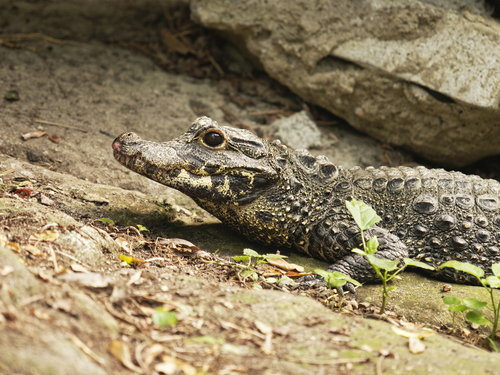
Dwarf Crocodile
Osteolaemus tetraspis
The Dwarf Crocodile is the world's smallest living crocodilian, a heavily armored 'living fossil' that prowls the dark, swampy corridors of Africa's rainforests. Shy and elusive, this 'bony crocodile' is a master of the nocturnal shadows.
Quick Identification
Size
Length: 1.5–1.9 meters (4.9–6.2 feet); Weight: 18–32 kg (40–70 lbs)
Colors
Uniformly dark brown to blackish on the back; belly is yellowish with distinct black blotches
Key Features
- Smallest living crocodilian species
- Extremely heavy 'bony' armor on neck and back
- Short, blunt snout compared to other crocodilians
- Yellowish belly with dark spotting
When You’ll See Them
Geographic range
Where Does the Dwarf Crocodile Live?
The Dwarf Crocodile is a native resident of the tropical forest belts of West and Central Africa. Its core range begins in Senegal and stretches eastward through the humid coastal forests of the Gulf of Guinea into the massive Congo River Basin. You will find the highest population densities in the river systems of Gabon, Cameroon, and the Democratic Republic of the Congo, where the dense canopy provides the shaded, slow-moving water they require to thrive. This species is strictly African and has no introduced populations elsewhere in the wild.
Basemap © OpenStreetMap contributors
Behavior
During the rainy season, these crocodiles often migrate into the flooded forest floor to hunt, while the dry season finds them congregating in permanent pools or deep burrows. They are known for their unique 'bony' appearance caused by heavy ossified scales called osteoderms, which provide a layer of protection against both predators and the abrasive environment of the tropical jungle floor.
EverydayEarth exclusive
Camera Tips
During the dry season, concentrate your efforts on the last remaining deep pools in forest streams, as crocodiles will be forced to congregate there. In the wet season, look for shallow, flooded depressions inside the forest where they may be foraging for frogs or insects. Setting the camera to video mode (15-20 seconds) is often more rewarding than still photos, as it captures their slow, deliberate walk and the way they move their tails through the leaf litter.
Trigger speed is crucial. Since they often stay partially submerged with only their eyes and snout visible, you want a camera that fires instantly when it detects heat and motion. If you are struggling to get them to stop in front of the lens, a scent lure such as oily canned sardines or a small piece of chicken can be effective, but be prepared for other forest scavengers like mongooses or monitor lizards to show up first. Ensure your camera housing is extremely waterproof, as the high humidity of their habitat can easily lead to lens fogging or internal corrosion.
Similar Species
Species that look similar or are commonly confused with Dwarf Crocodile.
Frequently Asked Questions
Record Dwarf Crocodile at your habitat
Connect a camera to start building your own species record — AI identifies every visitor automatically.