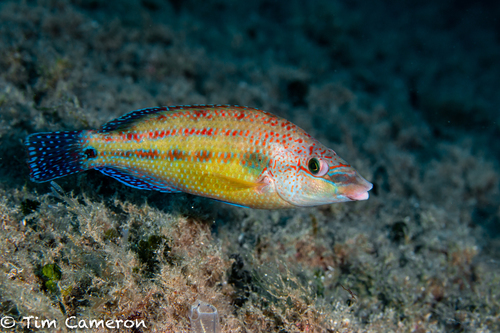
East Atlantic Peacock Wrasse
Symphodus tinca
The East Atlantic Peacock Wrasse is the Mediterranean's living rainbow. With its kaleidoscopic colors and inquisitive personality, this reef-dweller is a favorite for underwater observers and coastal backyard explorers alike.
Quick Identification
Size
Standard length typically ranges from 15 to 25 cm (6-10 in), with exceptional individuals reaching up to 44 cm (17 in).
Colors
Highly dimorphic; females and juveniles are generally olive-green or brownish with dark longitudinal stripes. Breeding males are spectacular, displaying vibrant green, blue, and yellow scales with red spots or streaks.
Key Features
- Pointed snout with prominent, fleshy lips
- Dark spot at the base of the pectoral fin
- Small dark spot on the base of the caudal (tail) fin
- Two or three dark, horizontal bands running along the sides
When You’ll See Them
Geographic range
Where Does the East Atlantic Peacock Wrasse Live?
This vibrant wrasse is native to the warm-temperate waters of the Eastern Atlantic Ocean, stretching from the Bay of Biscay down to the Moroccan coast. Its core population resides within the Mediterranean Sea and the Black Sea, where it is one of the most common shore fishes. While predominantly a marine species, it is also frequently found in coastal lagoons where salinity levels may fluctuate.
Basemap © OpenStreetMap contributors
Behavior
The East Atlantic Peacock Wrasse is a busy, diurnal fish that spends its daylight hours patrolling rocky reefs and seagrass meadows. Unlike many other wrasse species that are highly social or form large schools, the Peacock Wrasse is often observed as a solitary forager, though they may congregate in areas with abundant food. They are known for their inquisitive nature and are often the first fish to investigate a disturbed patch of seabed or a new object in their environment.
During the breeding season in spring and early summer, their social dynamics shift dramatically. Males become highly territorial, selecting a specific site on a rock or among seaweed. While some other wrasses build complex nests of algae, the Peacock Wrasse male primarily focuses on cleaning a rock surface to attract females. After the female deposits her eggs, the male diligently guards the site from egg-eating predators until the larvae hatch.
EverydayEarth exclusive
Camera Tips
Capturing the East Atlantic Peacock Wrasse requires an underwater camera setup, such as a GoPro or a specialized marine trail camera housed in a waterproof casing. For the best results, mount your camera to a fixed structure like a dock piling or a weighted tripod placed near the edge of a seagrass bed and a rocky outcrop. These 'ecotones' or transition zones are high-traffic corridors for wrasses looking for both food and shelter.
To attract these curious fish to your lens, use a 'chum' approach rather than traditional bait. Crushing a few local mussels or a sea urchin near the camera site will release scents that Peacock Wrasses find irresistible. They are highly visual hunters, so the movement of small particles in the water will quickly draw them in for a close-up inspection. Ensure your camera is set to a high frame rate (60fps or higher) to capture their quick, darting pectoral fin movements.
Natural lighting is your best friend when trying to showcase the Peacock Wrasse's iridescent colors. Place your camera at depths between 2 and 5 meters during the midday hours when the sun is directly overhead. This allows the red and yellow pigments in the male's scales to pop without being washed out by the blue-filtering effect of deeper water. If the water is murky, use a red filter or a small underwater video light to restore the natural color balance.
During the spring breeding season, look for males that seem to be 'cleaning' a specific patch of rock. If you find one, leave your camera nearby; the male's territorial instinct will keep him in the frame for extended periods. He may even display 'fanning' behaviors or aggressive postures toward the camera lens if he sees his own reflection, providing excellent behavioral footage.
Similar Species
Species that look similar or are commonly confused with East Atlantic Peacock Wrasse.
Frequently Asked Questions
Record East Atlantic Peacock Wrasse at your habitat
Connect a camera to start building your own species record — AI identifies every visitor automatically.