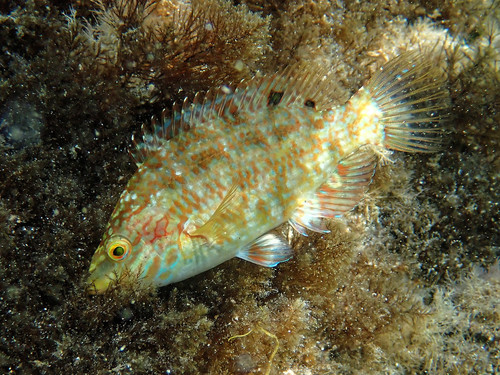
Five-spotted Wrasse
Symphodus roissali
A vibrant and industrious resident of Mediterranean reefs, the Five-spotted Wrasse is a master architect known for building complex seaweed nests. Its colorful presence and active personality make it a highlight for any underwater observer.
Quick Identification
Size
Typically 12 cm (4.7 in) in length, reaching a maximum of 17 cm (6.7 in).
Colors
Highly variable; breeding males are vibrant green or red with marbled patterns. Females and juveniles are usually olive-green or brown with two dark longitudinal bands.
Key Features
- Five distinct dark spots along the base of the dorsal fin
- Small, pointed snout with thick lips
- A dark spot often present at the base of the caudal fin (tail)
- Stocky, oval-shaped body
When You’ll See Them
Geographic range
Where Does the Five-spotted Wrasse Live?
The Five-spotted Wrasse is native to the temperate and subtropical coastal waters of the Eastern Atlantic Ocean, stretching from the Bay of Biscay down to the shores of Morocco. It is a quintessential inhabitant of the Mediterranean Sea, where it is found across nearly all coastal regions, and it also extends its range through the Bosporus into the Black Sea. This species is a non-migratory resident of these coastal zones, rarely venturing far from its preferred shallow-water habitats.
Basemap © OpenStreetMap contributors
Behavior
The Five-spotted Wrasse is a highly active and diurnal species, meaning it is most energetic during daylight hours. Unlike many other wrasse species that are protogynous hermaphrodites (starting life as female and turning male), the Five-spotted Wrasse has fixed sexes from birth. They are social creatures but become intensely territorial during the spring and summer breeding seasons. Dominant males spend a significant amount of time building and defending elaborate nests made of various algae species.
In their natural environment, they are curious foragers, weaving through seagrass and pecking at rocky surfaces. While they are not typically afraid of humans, they are quick to dart into the safety of thick eelgrass or rocky crevices if they perceive a threat. Their complex social hierarchy involves not just dominant males and females, but also 'satellite' males that attempt to fertilize eggs in the nests of more dominant individuals.
EverydayEarth exclusive
Camera Tips
Capturing the Five-spotted Wrasse requires an underwater camera setup positioned in the 'goldilocks zone'—typically between 1 and 3 meters of depth. Look for transitional areas where rocky substrate meets lush seagrass beds; these are the primary foraging highways for this species. To ensure clear footage, orient your camera so the sun is behind it, illuminating the fish’s vibrant colors without creating a silhouette effect.
During the spring breeding season (April to June), look for small mounds of collected algae on the seafloor. These are nests built by the males. Placing a camera on a tripod a few feet away from a nest can yield incredible footage of territorial defense and courtship displays. Avoid placing the camera directly on the nest, as this will stress the fish and lead to abandonment.
Because these fish are relatively small and move quickly, use a high frame rate (at least 60fps) to capture their jerky, precise swimming movements. If your camera has a wide-angle lens, try to position it within 50 centimeters of a rocky edge where they pick off food. While you shouldn't feed wildlife, gently disturbing a small patch of sand or turning over a single loose rock near the camera can naturally attract these curious fish as they investigate the area for exposed tiny crustaceans.
Similar Species
Species that look similar or are commonly confused with Five-spotted Wrasse.
Frequently Asked Questions
Record Five-spotted Wrasse at your habitat
Connect a camera to start building your own species record — AI identifies every visitor automatically.