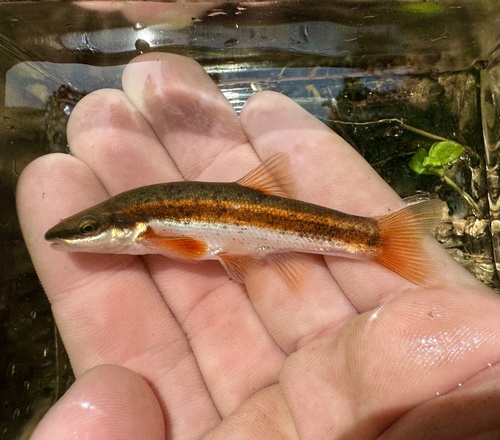
Eastern Blacknose Dace
Rhinichthys atratulus
A shimmering icon of the eastern mountain stream, the Eastern Blacknose Dace is known for its lightning-fast movements and striking 'racing stripe.' This social minnow brings life to backyard brooks and clear rocky rivers alike.
Quick Identification
Size
2 to 4 inches (5 to 10 cm) in length; typically weighs less than 1 ounce (28 grams).
Colors
Olive to dark brown back with a prominent black stripe along the side; silvery-white belly. Males develop bright orange or red lateral fins and stripes during breeding.
Key Features
- Distinct dark lateral line running from snout to tail
- Slender, torpedo-shaped body
- Small mouth positioned slightly downward for bottom feeding
- Scales that appear shimmering or iridescent in sunlight
When You’ll See Them
Geographic range
Where Does the Eastern Blacknose Dace Live?
Native to the North American continent, the Eastern Blacknose Dace is widely distributed across the southeastern provinces of Canada and the eastern United States. Its core range follows the Appalachian Mountains and the Atlantic coastal plain, extending from the maritime regions down through New England and into the Deep South, reaching parts of Georgia and Alabama. It thrives in the headwaters of most major eastern river systems.
Basemap © OpenStreetMap contributors
Behavior
The Eastern Blacknose Dace is a highly energetic and social species, often found in small schools darting between rocks. Its name is derived from the Old French word for 'dart,' which perfectly describes its quick, jerky swimming style used to navigate fast-moving currents. They spend much of their time near the stream bed, searching for food among the gravel and avoiding larger predators like trout.
While they are somewhat shy, they are incredibly curious and will often investigate changes in their environment, such as a camera placed in the water. During the spring spawning season, their social structure becomes more complex as males establish small territories and display vibrant colors to attract mates. They are an essential part of the food web, serving as a primary food source for many larger freshwater game fish.
EverydayEarth exclusive
Camera Tips
To capture the Eastern Blacknose Dace on camera, you will need a waterproof action camera or a dedicated underwater trail camera. Look for 'riffles'—areas where water ripples over rocks—and place the camera in the calmer pool just downstream. Position the lens as close to the bottom as possible, ideally using a weighted mount or a 'sandbag' camera base to keep it steady in the current. Angle the lens slightly upward to take advantage of the natural light filtering through the water surface.
While traditional bait isn't always necessary, you can attract a school of dace by gently disturbing the upstream gravel with your foot before setting the camera; this releases natural larvae and 'drift' into the current, which will bring the fish right to your lens. If you choose to use a lure, a small mesh bag with crushed fish flakes or shrimp can create a scent trail that keeps them in frame for longer periods.
Sunlight is your best friend for underwater photography. Aim to record during the middle of the day (10 AM to 2 PM) when the sun is directly overhead, as this will illuminate the dace's silver scales and the dark lateral line. During the spring, focus your efforts on shallow, sun-drenched gravel beds where the males' bright orange breeding colors will pop against the rocky background. Set your camera to a high frame rate (60fps) to keep their fast 'darting' movements from appearing as a blur.
Similar Species
Species that look similar or are commonly confused with Eastern Blacknose Dace.
Western Blacknose Dace
Nearly identical in appearance but found west of the Appalachian Mountains; they are geographically separated from the Eastern species.
Longnose Dace
Has a much longer, prominent snout that overhangs the mouth and lacks the distinct dark lateral stripe found on the Blacknose Dace.
Creek Chub
Grows much larger (up to 12 inches) and has a more robust body with a distinct black spot at the base of the dorsal fin.
Frequently Asked Questions
Record Eastern Blacknose Dace at your habitat
Connect a camera to start building your own species record — AI identifies every visitor automatically.