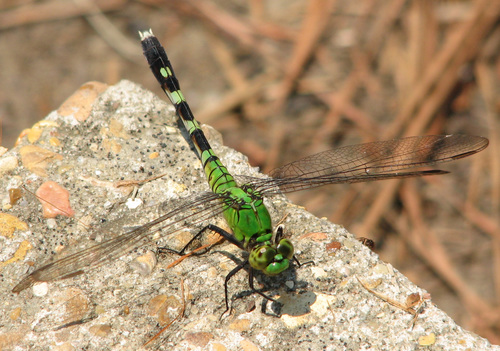
Eastern Pondhawk
Erythemis simplicicollis
The Eastern Pondhawk is a fearless aerial predator that transforms from a brilliant emerald green to a dusty sky blue as it matures. A common visitor to backyard ponds, this 'flying shark' is a master of the hunt and a jewel of the insect world.
Quick Identification
Size
Length 38–48 mm (1.5–1.9 in); Wingspan 60–75 mm (2.4–3.0 in)
Colors
Females/immatures are bright emerald green with dark abdominal bands; mature males are powdery blue (pruinose) with green faces.
Key Features
- Distinctive white terminal appendages (cerci) on both sexes
- Mature males have a dusty blue abdomen and green face
- Females are vivid green with square-shaped black spots on the abdomen
- Square-shaped 'stigmas' (wing spots) are usually light brown or yellowish
When You’ll See Them
Geographic range
Where Does the Eastern Pondhawk Live?
The Eastern Pondhawk is a quintessential North American species, primarily found throughout the eastern two-thirds of the United States. Its territory stretches from the Atlantic coast westward to the Great Plains, reaching as far as Texas and New Mexico. To the north, its range extends into the southern reaches of Ontario and Quebec, Canada, where it thrives in the warm wetland corridors of the Great Lakes region. It is also commonly found throughout Mexico, making it one of the most widespread dragonflies on the continent.
Basemap © OpenStreetMap contributors
Behavior
The Eastern Pondhawk is widely considered one of the most aggressive and successful hunters in the dragonfly world. Often nicknamed the 'flying shark,' this species doesn't just settle for small gnats; it is well-known for attacking and consuming other dragonflies and damselflies, sometimes nearly its own size. They are 'perchers' by nature, meaning they spend much of their time sitting on low-lying vegetation, flat rocks, or even the bare ground, darting out with explosive speed to snatch prey from the air before returning to their lookout.
Socially, males are highly territorial. They patrol the edges of ponds and lakes, vigorously chasing away rival males to maintain control over the best breeding spots. Unlike many other dragonflies that prefer high perches, Pondhawks are uniquely comfortable near the ground. They are also relatively bold around humans, often allowing for close observation if you move slowly, making them a favorite for backyard naturalists and macro photographers alike.
EverydayEarth exclusive
Camera Tips
To capture high-quality images of the Eastern Pondhawk, focus your camera efforts on the 'hot zones' where they hunt and defend territory. Unlike many dragonflies that stay high in the canopy, Pondhawks love low perches. Set your AI-powered camera or tripod-mounted rig to point at flat stones, floating lily pads, or low-hanging leaves within three feet of the water's edge. If you are in a backyard setting, a simple bamboo stake or a garden trellis near a water feature can serve as an irresistible 'hunting throne' for these insects.
Because dragonflies are cold-blooded, they are most active when the sun is at its peak. The best lighting and activity levels occur between 10 AM and 4 PM. Use a high shutter speed (at least 1/1000s) to freeze the motion of their wings, as they can accelerate instantly. If your camera allows for manual focus zones, pre-focus on a likely perch. This species is particularly fond of sunning itself, so ensure your chosen perch is in a spot that receives direct sunlight for several hours a day.
While you cannot bait dragonflies with food like you can with birds, you can 'bait' them with habitat. Maintaining a small pond with emergent vegetation (plants that grow out of the water) is the best way to ensure they visit daily. During the peak of summer, keep an eye out for the 'obelisk posture'—where the dragonfly points its abdomen straight up toward the sun to regulate its body temperature. This dramatic pose makes for some of the most striking wildlife photography you can capture in a backyard setting.
Similar Species
Species that look similar or are commonly confused with Eastern Pondhawk.
Blue Dasher
Blue Dashers have a distinct metallic turquoise face and yellow stripes on the thorax, whereas male Pondhawks have green faces.
Western Pondhawk
Nearly identical but found west of the Great Plains; males have more black on the tip of the abdomen.
Great Blue Skimmer
Much larger than the Pondhawk with a distinctive white face and darker wing bases.
Frequently Asked Questions
Record Eastern Pondhawk at your habitat
Connect a camera to start building your own species record — AI identifies every visitor automatically.