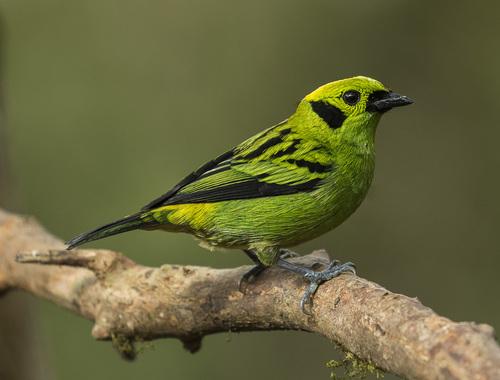
Emerald Tanager
Tangara florida
A jewel of the tropical canopy, the Emerald Tanager glows with a brilliance that defies description. With its neon-green feathers and golden crown, this small but striking bird is a masterpiece of the Central and South American rainforests.
Quick Identification
Size
10.6–13 cm (4.2–5.1 in); 18–20.5 g (0.63–0.72 oz)
Colors
Brilliant emerald green body with black streaking on the back; males have a bright yellow crown and rump, while females are slightly duller with yellow-green heads.
Key Features
- Bright emerald green plumage
- Yellow crown and rump
- Distinctive black auricular (ear) patch
- Black streaking on wings and back
When You’ll See Them
Geographic range
Where Does the Emerald Tanager Live?
The Emerald Tanager is native to the lush, humid tropical regions of Central and South America. Its core range follows the Caribbean and Pacific slopes, stretching from the highlands of Costa Rica and Panama down through western Colombia and into northwestern Ecuador. These birds are most commonly found in high-rainfall zones where primary forest and old-growth secondary forests provide the dense, mossy limbs they favor for foraging.
Basemap © OpenStreetMap contributors
Behavior
The Emerald Tanager is a high-energy inhabitant of the forest canopy, known for its restless movement as it hops through mossy branches. They are social birds, frequently seen in pairs or small groups, and are quintessential participants in mixed-species foraging flocks, often traveling alongside other tanagers, honeycreepers, and wood-warblers.
While they spend much of their time high above the ground, they are relatively bold and will descend to lower levels when food is abundant or when visiting fruiting trees. Their social nature means they are rarely found alone, and their presence is often signaled by high-pitched, metallic 'tsit' calls. Interactions with humans are generally passive, though they are increasingly frequent visitors to bird-friendly gardens located near forest edges.
EverydayEarth exclusive
Camera Tips
To capture the stunning neon greens of the Emerald Tanager, position your AI-powered camera near high-canopy fruit feeders or natural 'hotspots' like fruiting Melastome shrubs. Because these birds prefer mossy environments, mounting your camera at a height of 6 to 10 feet on a branch covered in epiphytes can provide a natural-looking backdrop that mimics their preferred foraging habitat. Ensure the lens is shaded from direct midday sun to prevent the bright plumage from appearing washed out in the exposure.
While they are primarily canopy dwellers, Emerald Tanagers can be lured closer to the ground with sliced bananas or plantains. Placing these on a platform feeder near the forest edge is highly effective. If you are using a camera with motion detection, set the sensitivity to high, as these birds move with quick, darting motions. Because they often travel in mixed flocks, one bird usually signals the arrival of many others, so set your camera to take bursts of photos or short videos to catch the social interaction.
Lighting is crucial for this species; their iridescent green feathers look best in soft, diffused morning light. Avoid using heavy flashes which can startle them; instead, rely on high-shutter-speed settings to freeze their fast movements. If your camera allows for schedule-based recording, prioritize the three hours after sunrise, as this is when their foraging activity is at its peak and the light is most flattering for their vivid colors.
Similar Species
Species that look similar or are commonly confused with Emerald Tanager.
Frequently Asked Questions
Record Emerald Tanager at your habitat
Connect a camera to start building your own species record — AI identifies every visitor automatically.