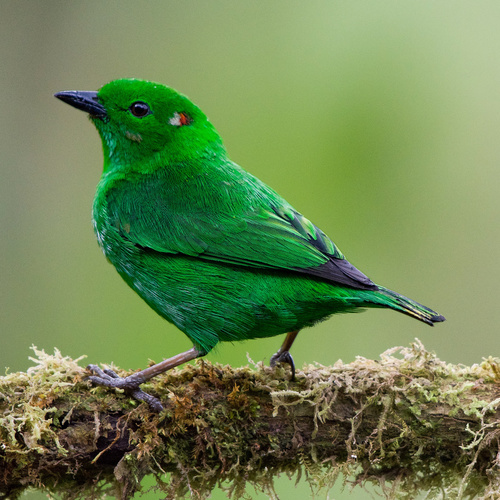
Glistening-green Tanager
Chlorochrysa phoenicotis
The Glistening-green Tanager is a living emerald of the Andean cloud forests. With its luminous plumage and energetic personality, it is one of the most breathtaking visitors you can find on a backyard bird camera in Colombia or Ecuador.
Quick Identification
Size
Length: 12–13 cm (4.7–5.1 in); Weight: 17–22 g (0.6–0.8 oz)
Colors
Brilliant, iridescent emerald green overall; small orange-red ear spot paired with a smaller yellow spot behind the eye; black bill and dark legs.
Key Features
- Solid shimmering emerald green plumage
- Small red and yellow 'ear' markings behind the eye
- Short, stout black bill
- Found primarily in the mossy cloud forests of the Andes
When You’ll See Them
Geographic range
Where Does the Glistening-green Tanager Live?
Native to the lush western slopes of the South American Andes, the Glistening-green Tanager is a regional specialty of the Chocó bioregion. Its range is concentrated in western Colombia and northwestern Ecuador, where it thrives in the high-humidity environment of montane cloud forests. Because of its specific habitat needs, it is not found outside of these two countries, making it a prized sighting for birdwatchers visiting the Andean foothills.
Basemap © OpenStreetMap contributors
Behavior
The Glistening-green Tanager is a high-energy bird often found moving through the upper canopy of humid forests. Unlike some more solitary species, it is highly social and frequently joins mixed-species foraging flocks, traveling alongside other tanagers, honeycreepers, and flowerpiercers. They are remarkably acrobatic, often seen clinging to the undersides of mossy branches or hovering briefly to pluck a berry.
While they can be shy in deep primary forests, they have become quite habituated to humans in areas where fruit feeders are maintained. At these sites, they can be surprisingly dominant despite their small size, darting in quickly to grab a snack before returning to the safety of the foliage. Their flight is direct and undulating, typical of many small Andean forest birds.
EverydayEarth exclusive
Camera Tips
To capture the stunning iridescence of the Glistening-green Tanager, lighting is your most important factor. If your camera is placed in deep shade, the bird may appear as a simple dark shape. Aim for a spot that receives dappled morning sunlight or use a high-quality external flash with a diffuser to make those emerald feathers pop. Positioning the camera at a slight downward angle toward a mossy perch can help showcase the back and crown, where the shimmer is most intense.
If you are setting up a camera in a backyard or lodge garden within their range, fruit is the ultimate lure. Overripe bananas or plantains are their favorite. Instead of placing the fruit on a flat plastic tray, try 'plating' the fruit on a naturally lichen-covered branch or inside a hollowed-out log. This creates a much more natural-looking photo and encourages the bird to land in a predictable spot for your AI trigger.
Because these birds are fast and rarely sit still for long, use a high shutter speed (at least 1/1000s if your camera allows manual overrides) or a specialized 'bird mode' on your AI camera. They are most active in the early morning hours just after sunrise, so ensure your camera is positioned to catch the early light without pointing directly into the sun, which can cause lens flare and wash out the green saturation.
Finally, consider the background. These birds live in extremely green environments. To make the bird stand out from the leaves, try to position your camera so there is some distance between the perch and the background foliage. This creates a soft 'bokeh' effect that separates the shimmering green bird from the static green forest, making for a much more professional wildlife portrait.
Similar Species
Species that look similar or are commonly confused with Glistening-green Tanager.
Grass-green Tanager
Much larger with a bright red bill and legs, lacking the shimmering iridescence and ear spots of the Glistening-green.
Orange-eared Tanager
Features a black face mask and a much larger, more prominent orange patch on the side of the head.
Green Honeycreeper
The male is more teal-green with a distinct black 'hood' or cap and a longer, down-curved yellow bill.
Frequently Asked Questions
Record Glistening-green Tanager at your habitat
Connect a camera to start building your own species record — AI identifies every visitor automatically.