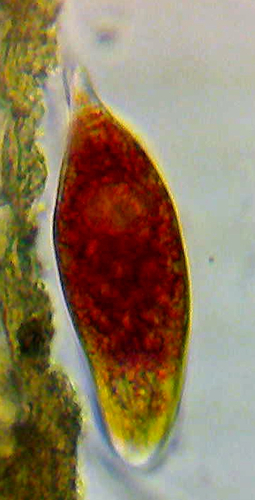
Euglena sanguinea
Euglena sanguinea
Witness the microscopic magic that turns local ponds a brilliant shade of crimson. Euglena sanguinea is a shape-shifting marvel that uses natural 'sunscreen' to paint the water's surface.
Quick Identification
Size
30–150 micrometers (0.001–0.006 inches) in length; invisible to the naked eye individually.
Colors
Brilliant blood-red due to astaxanthin pigments, occasionally transitioning to green in low-light conditions.
Key Features
- Spindle-shaped unicellular body
- Vibrant red coloration in direct sunlight
- Single whip-like flagellum for movement
- Small reddish eyespot (stigma) near the anterior end
When You’ll See Them
Geographic range
Where Does the Euglena sanguinea Live?
Euglena sanguinea is a cosmopolitan species found on every continent except Antarctica. It is widely distributed across North America, Europe, and Asia, particularly in temperate and subtropical zones where freshwater bodies are prone to nutrient enrichment. While naturally occurring, it is most frequently sighted in agricultural regions of the United States, China, and Western Europe, where nitrogen and phosphorus levels in the water support rapid cell division.
Basemap © OpenStreetMap contributors
Behavior
Euglena sanguinea is a fascinating single-celled organism that exhibits characteristics of both plants and animals. It is a mixotroph, meaning it can produce its own energy through photosynthesis like a plant using its chloroplasts, but it can also absorb organic nutrients from the surrounding water like an animal. This adaptability allows it to thrive in nutrient-rich freshwater environments where other species might struggle.
The most striking behavior of this species is its protective response to intense sunlight. When exposed to high UV levels, the cell mobilizes a red pigment called astaxanthin, which covers its green chlorophyll to prevent damage. This collective behavior of millions of cells results in a 'blood-red' bloom on the surface of ponds. At night or during cloudy weather, the cells may migrate deeper into the water column or shift their pigments, often causing the water to return to a green or clear appearance in a matter of hours.
EverydayEarth exclusive
Camera Tips
Capturing Euglena sanguinea on a backyard camera requires focusing on the water's surface rather than looking for an individual 'animal.' To document a bloom, position your camera on a tripod at a 45-degree angle facing a still pond or birdbath. Because the AI might not recognize it as a single organism, look for the 'red tide' effect. Set your camera to record time-lapse footage during the middle of a hot, sunny day; you will see the water surface transform from green or brown to a vivid crimson as the cells rise to the surface.
For those using specialized macro lenses or digital microscope attachments, take a water sample from the red film on the surface. These organisms are highly active and move in a spiraling fashion. Use a high shutter speed or high-frame-rate video (60fps or higher) to capture their 'metaboly'—a unique type of movement where the cell body distorts and pulses to change direction. This movement is a key diagnostic feature for the genus Euglena.
If you want to trigger a 'visit' from this species for your camera, ensure your pond has a sunny spot with very little water movement. Adding organic material like straw or dried leaves to a container of water and placing it in direct sunlight can often induce a localized bloom within a few weeks. Monitor the water temperature, as Euglena sanguinea thrives when the water is warm (above 20°C/68°F), making late summer the ideal time for filming.
Similar Species
Species that look similar or are commonly confused with Euglena sanguinea.
Frequently Asked Questions
Record Euglena sanguinea at your habitat
Connect a camera to start building your own species record — AI identifies every visitor automatically.