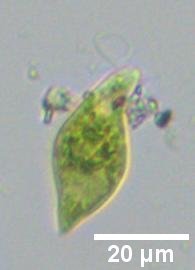
Euglena viridis
Euglena viridis
The shape-shifting green marvel of your garden pond. Euglena viridis is a microscopic powerhouse that acts like both a plant and an animal, turning sunlight into a vibrant dance of life.
Quick Identification
Size
40 to 65 micrometers in length (0.0016 to 0.0025 inches)
Colors
Vibrant grass-green body; distinctive bright red eyespot (stigma) at the anterior end
Key Features
- Spindle-shaped or fusiform body
- Single whip-like flagellum for movement
- Bright red light-sensitive eyespot
- Flexible outer membrane allowing for 'euglenoid' shape-shifting
When You’ll See Them
Geographic range
Where Does the Euglena viridis Live?
Euglena viridis is a cosmopolitan microorganism with a truly global distribution, found on every continent except Antarctica. It is most prevalent in the temperate regions of North America, Europe, and Asia, where it thrives in stagnant water bodies enriched by organic matter or agricultural runoff. Because of its ability to survive in a dormant cyst state, it is frequently spread by wind or on the feet of migrating waterfowl, allowing it to colonize almost any suitable freshwater habitat worldwide.
Basemap © OpenStreetMap contributors
Behavior
Euglena viridis is a fascinating single-celled organism that occupies a unique space between the plant and animal kingdoms. It exhibits a behavior called positive phototaxis, where it uses its red eyespot to detect light and then moves toward it to maximize the efficiency of its chloroplasts. When swimming, it uses a long, whip-like flagellum to pull itself through the water, often rotating its body in a characteristic spiral motion.
One of its most distinctive behaviors is 'metaboly' or euglenoid movement. Because it lacks a rigid cell wall, it can scrunch its body into a sphere and then elongate again, allowing it to squeeze through tight spaces in pond sediment. While they are solitary cells, they often congregate in massive numbers near the surface of still water, creating a film that can turn a backyard pond entirely green in a matter of hours.
EverydayEarth exclusive
Camera Tips
Capturing Euglena viridis on a backyard camera requires a specialized approach since they are far too small for standard trail cameras. To document these 'backyard monsters,' you will need a digital microscope camera or a high-quality macro lens attachment for your smartphone. The best method is to collect a water sample from the surface of a green-tinted puddle or pond. Place a few drops into a shallow petri dish or onto a concave slide. Position your lens directly above the sample and use a strong, diffused light source from below to illuminate the internal structures.
For the most engaging footage, set your camera to a time-lapse mode. Over a period of 10 to 30 minutes, you can capture the 'bloom' effect as the cells aggregate toward the strongest light source. If you are using an AI-powered camera system, ensure your focus is locked; the rapid, jerky movement of the flagellum can sometimes cause autofocus systems to hunt. Look for the distinctive red eyespot, which provides a high-contrast point of interest for the AI to track against the green body.
You can 'bait' Euglena into your field of view by using a targeted light source. In a dark room, if you shine a small LED at one side of your water sample, the Euglena will migrate toward the light, creating a high-density area perfect for photography. Seasonal timing is also key: late spring and summer are the best times to find them in backyard habitats, particularly after a period of warm, sunny weather following a rainstorm, which washes nutrients into the water and triggers a population explosion.
Similar Species
Species that look similar or are commonly confused with Euglena viridis.
Euglena sanguinea
While E. viridis turns water green, E. sanguinea produces a red pigment that can make pond surfaces look like they are covered in red oil or blood.
Phacus
Phacus is closely related but has a very rigid, flat, leaf-shaped body and cannot change its shape like the flexible E. viridis.
Frequently Asked Questions
Record Euglena viridis at your habitat
Connect a camera to start building your own species record — AI identifies every visitor automatically.