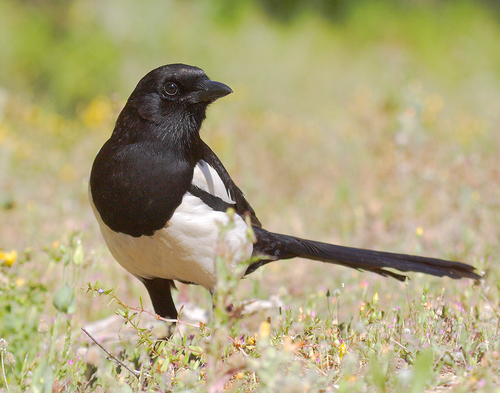
Eurasian Magpie
Pica pica
The Eurasian Magpie is the intelligent, iridescent jewel of the backyard. Known for their striking monochrome plumage and legendary problem-solving skills, these charismatic corvids are a favorite for bird-watchers and camera enthusiasts alike.
Quick Identification
Size
Length: 44–46 cm (17–18 in); Wingspan: 52–62 cm (20–24 in); Weight: 200–250 g (7.1–8.8 oz)
Colors
Bold black and white plumage; head, breast, and back are black; belly and shoulder patches are pure white; wings and long tail exhibit brilliant metallic blue, green, and purple iridescence.
Key Features
- Extremely long, wedge-shaped iridescent tail
- Bold monochrome black-and-white pattern
- Powerful, heavy black beak
- White wing patches visible in flight
When You’ll See Them
Geographic range
Where Does the Eurasian Magpie Live?
Native to the vast temperate regions of the Eurasian continent, the Eurasian Magpie is a highly successful resident from the British Isles and Western Europe through Russia to the Pacific coast of China and Japan. While they are found as far south as Northwest Africa, their core population density remains in the mid-latitudes of Europe and Central Asia. They are remarkably adaptable, having expanded their range into urban and suburban environments throughout the 20th century.
Basemap © OpenStreetMap contributors
Behavior
Eurasian Magpies are among the most intelligent animals on the planet, famously being the first non-mammal species proven to possess self-recognition in mirror tests. In your backyard, they are inquisitive and bold, often the first birds to investigate a new object or food source. They live in complex social structures, usually seen in devoted pairs during the breeding season or small family groups that work together to defend territory from rivals or predators like domestic cats.
These corvids are highly vocal, using a series of rapid 'chak-chak' alarm calls to alert other birds of danger. While they have a reputation as 'thieves' of shiny objects, this is largely a myth; their real interest is food. They are meticulously organized, often caching surplus food in shallow holes in the ground and covering them with leaves or stones to retrieve later. Their flight is characteristic, featuring a series of heavy wingbeats followed by a graceful glide, showing off their long, streaming tails.
EverydayEarth exclusive
Camera Tips
To capture high-quality footage of Eurasian Magpies, place your camera approximately 0.5 to 1 meter off the ground. These birds are primary ground-feeders, so a low-angle shot will capture their hopping movements and the full length of their impressive tails. Aim the camera toward an open patch of lawn or a flat, low-lying platform where they feel safe landing and scanning for predators.
Because magpies are exceptionally clever, they may be wary of a new camera. To encourage them to linger, offer a 'high-value' lure like unsalted peanuts (in the shell provides better video as they struggle to crack them), suet pellets, or dried mealworms. Scatter the food in a small 1-meter radius to keep the bird within the camera's focal range. If you have a bird bath, this is another excellent focal point, as magpies are frequent and enthusiastic bathers.
Lighting is crucial for capturing their iridescence. Position your camera facing north or south so the sun strikes the bird from the side or front; direct morning or afternoon sunlight will make the blue and green sheen on their wings and tail shimmer vividly against the black feathers. Set your camera to a fast trigger speed or high-frame-rate video, as their head movements are quick and they can be flighty if they sense movement nearby.
Similar Species
Species that look similar or are commonly confused with Eurasian Magpie.
Iberian Magpie
Smaller with a distinct azure-blue tail and wings, and a soft grey-pink body rather than the bold white belly.
Carrion Crow
Slightly larger and entirely black with no white markings and a much shorter, square-ended tail.
Common Raven
Much larger with a massive beak and shaggy throat feathers; lacks the white patches and colorful iridescence of the magpie.
Frequently Asked Questions
Record Eurasian Magpie at your habitat
Connect a camera to start building your own species record — AI identifies every visitor automatically.