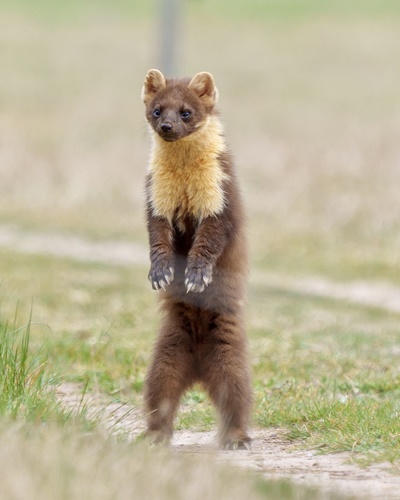
Eurasian Pine Marten
Martes martes
Meet the forest's most acrobatic hunter. With its plush chocolate fur and striking golden bib, the Eurasian Pine Marten is a master of the canopy that is slowly returning to its ancestral woodland homes.
Quick Identification
Size
Body length 45-58 cm (18-23 in), tail 16-28 cm (6-11 in); weighs 0.8-1.8 kg (1.8-4 lbs)
Colors
Rich chocolate brown fur with a distinctive cream or apricot-colored throat patch; dark brown legs and a bushy tail
Key Features
- Prominent cream to yellow-orange throat patch (bib)
- Large, rounded ears with pale margins
- Bushy, dark brown tail nearly half the body length
- Semi-retractable claws for expert climbing
When You’ll See Them
Geographic range
Where Does the Eurasian Pine Marten Live?
Native to the European continent and parts of Western Asia, the Eurasian Pine Marten thrives across a vast territory stretching from the British Isles to the Ural Mountains. This resilient predator is a core resident of the deep forests in Scandinavia, the Scottish Highlands, and the mountainous regions of Central Europe, where it maintains stable populations in undisturbed woodlands.
Basemap © OpenStreetMap contributors
Behavior
The Eurasian Pine Marten is a highly energetic and solitary mammal known for its incredible agility. While they are often described as arboreal, they spend a significant amount of time hunting on the forest floor, though they will retreat to the canopy at the first sign of danger. They are territorial creatures, marking their large home ranges with scent glands to ward off rivals, only coming together briefly during the mid-summer mating season.
These mustelids are crepuscular and nocturnal, meaning they are most active during the twilight hours and throughout the night. They are famously curious but elusive, often investigating new objects in their environment with a mix of caution and boldness. Despite their sweet appearance, they are formidable predators, capable of chasing squirrels through the treetops with terrifying speed and precision.
EverydayEarth exclusive
Camera Tips
To capture the perfect shot of a Eurasian Pine Marten, think vertically. Unlike many backyard visitors, martens love to travel along horizontal branches and log piles. Mount your camera about 1.5 to 2 meters high on a tree trunk, angled slightly downward toward a sturdy branch or a baited platform. If you are using a trail camera in a garden, placing it near a woodpile or a dense treeline will yield the best results.
Martens have a legendary sweet tooth, which makes baiting quite effective. A spoonful of fruit jam, peanut butter, or even a few chunks of honeycomb placed on a branch can keep them in front of the lens for several minutes. In winter, more protein-rich offerings like sardines or wet cat food are irresistible lures that will encourage them to pause during their nightly patrols.
Because these animals move with lightning speed, use a camera with a fast trigger speed (0.3 seconds or less) and set it to 'Burst Mode' to capture 3-5 photos per trigger. This increases your chances of getting a clear image rather than a brown blur. Since they are mostly active at night, ensure your camera has a high-quality infrared flash that won't spook them; 'no-glow' LEDs are preferable to prevent startling these naturally shy creatures.
Similar Species
Species that look similar or are commonly confused with Eurasian Pine Marten.
Frequently Asked Questions
Record Eurasian Pine Marten at your habitat
Connect a camera to start building your own species record — AI identifies every visitor automatically.