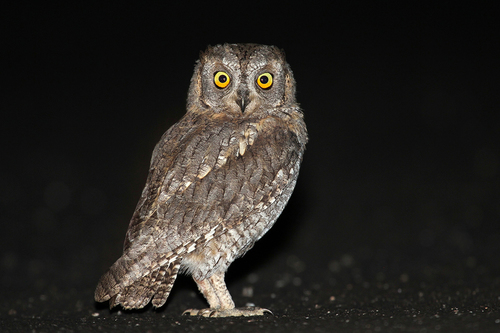
Eurasian Scops-Owl
Otus scops
A tiny master of camouflage with a hauntingly beautiful call, the Eurasian Scops-Owl is a hidden gem of the nocturnal world. Discover how this migratory insect-hunter transforms ordinary backyards into a stage for its nightly serenades.
Quick Identification
Size
Length: 19–21 cm (7.5–8.3 in); Wingspan: 47–54 cm (18.5–21.3 in); Weight: 60–135 g (2.1–4.8 oz)
Colors
Complex mottled grey-brown plumage (sometimes rufous) resembling tree bark; bright yellow irises; grey beak.
Key Features
- Small prominent ear tufts that can be raised or flattened
- Striking bright yellow eyes
- Highly cryptic 'bark-like' camouflage
- Long, narrow wings for a small owl
When You’ll See Them
Geographic range
Where Does the Eurasian Scops-Owl Live?
This small owl is native across a vast stretch of the Old World, originating in the warm temperate and Mediterranean regions of Europe and North Africa. Its core breeding range extends from the Iberian Peninsula eastward through southern Europe and Russia into the western Himalayas and Central Asia. As a long-distance migrant, most populations travel south for the winter, crossing the Mediterranean and Sahara to reach the savannas of sub-Saharan Africa, though some populations in the southernmost parts of Europe remain as year-round residents.
Basemap © OpenStreetMap contributors
Behavior
The Eurasian Scops-Owl is a master of disguise, spending its daylight hours perched motionlessly against tree trunks where its mottled plumage makes it nearly invisible. It is strictly nocturnal, emerging at dusk to hunt. Unlike larger owls, its flight is somewhat buoyant and erratic, reminiscent of a large moth or a nightjar as it maneuvers through branches to snatch insects.
Socially, they are often heard before they are seen. During the breeding season, males establish territories with a repetitive, flute-like 'tyook' call that can continue for hours with metronomic regularity. While they are generally solitary outside of the breeding season, they are surprisingly tolerant of human presence, often nesting in suburban parks or old orchards where hollow trees provide secure cavity sites.
EverydayEarth exclusive
Camera Tips
To capture the Eurasian Scops-Owl on camera, focus your efforts on 'singing posts' or potential nesting sites. During the spring, listen for the male's repetitive 'tyook' call; once you identify a frequent calling spot—often a prominent branch or the edge of a tree canopy—mount your camera about 2 to 3 meters (6-10 feet) high on an adjacent tree. Angle the lens slightly upward to catch the owl as it perches. Scops-owls are creatures of habit and will often return to the exact same branch night after night.
Since these owls are almost exclusively nocturnal, high-quality infrared (IR) flash is essential. Avoid white light flashes as they may spook the bird or wash out the intricate details of their camouflage. Set your camera to a fast trigger speed and 'burst mode' to capture the owl in flight or while it's adjusting its feathers. Because they are insect-hunters, placing a camera near a localized light source (like a porch light or a low-wattage garden light) that attracts moths can increase your chances of filming a hunting sequence.
If you have old trees with natural cavities or have installed owl nest boxes, position the camera 3-5 meters away from the entrance. The best time for this is during the late spring when the parents are busy feeding chicks. Ensure the camera has a clear line of sight, as Scops-owls are small and can easily be obscured by a single leaf. Check your batteries frequently, as the cold night air and frequent IR triggers can drain them faster than daytime monitoring.
Similar Species
Species that look similar or are commonly confused with Eurasian Scops-Owl.
Frequently Asked Questions
Record Eurasian Scops-Owl at your habitat
Connect a camera to start building your own species record — AI identifies every visitor automatically.