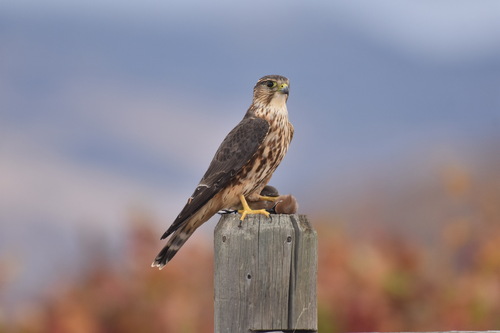
Merlin
Falco columbarius
A small but incredibly fierce falcon, the Merlin is a master of high-speed aerial pursuit. Once a rare sight in suburbia, these 'pocket rockets' are now frequenting backyards, drawn by the bounty of songbirds at garden feeders.
Quick Identification
Size
Length: 24–33 cm (9.4–13 in); Wingspan: 53–73 cm (21–29 in); Weight: 160–240 g (5.6–8.5 oz)
Colors
Males are slate-blue to blue-gray above with streaked buff underparts; females and juveniles are dusky brown with heavy brown streaking on the chest.
Key Features
- Small, compact, powerful build
- Pointed wings with rapid, 'rowing' wingbeats
- Broad, streaked chest and dark-banded tail
- Faint facial markings compared to other falcons
When You’ll See Them
Geographic range
Where Does the Merlin Live?
Native across the Northern Hemisphere, the Merlin maintains a massive breeding range across the taiga and prairies of North America and northern Eurasia. In the Western Hemisphere, they are found from Alaska and Canada down through the northern United States, with many populations migrating to the southern US, Central America, and northern South America for the winter. Interestingly, urban populations in the Pacific Northwest and the Great Plains are increasingly sedentary, staying in the same cities year-round due to the reliable food supply at backyard bird feeders.
Basemap © OpenStreetMap contributors
Behavior
The Merlin is a fierce and energetic predator, often described as a 'pocket rocket' of the falcon world. Unlike larger hawks that may soar lazily on thermals, Merlins are power-fliers, staying low to the ground and using rapid, continuous wingbeats to surprise their prey. They are incredibly bold and will often harass much larger raptors like Red-tailed Hawks or Eagles to drive them out of their territory.
In recent years, Merlins have become remarkably well-adapted to urban and suburban life. While they traditionally nested in the boreal forests and open prairies, many have moved into city parks and residential neighborhoods. They do not build their own nests, instead repurposing the old stick nests of crows, magpies, or hawks. They are generally solitary outside of the breeding season but are highly territorial and vocal when defending a nest site.
EverydayEarth exclusive
Camera Tips
To capture a Merlin on your backyard camera, focus your efforts on 'prey hubs' rather than the bird feeder itself. Since Merlins hunt other birds, they are drawn to the activity at feeders but will rarely land on one. Position your camera at a wide angle facing a bird bath or a common perching spot—like a dead branch or a tall fence post—where the falcon might pause to scan the area after a chase.
Because Merlins are incredibly fast, high-speed trigger settings are essential. If your camera has a 'Pro-Capture' or high-speed video mode, use it. They often fly in a straight, level line at high velocity, so a camera positioned with a side-view of a clearing or across a backyard flight path is more likely to catch them in frame than one facing a static object.
Water is a major draw. Merlins are known to bathe frequently, often at dawn or dusk. A ground-level camera focused on a large, sturdy bird bath can provide stunning close-up footage. During the winter, heated bird baths in northern climates are absolute magnets for resident Merlins looking for both a drink and a concentrated hunting ground for songbirds.
Similar Species
Species that look similar or are commonly confused with Merlin.
American Kestrel
Kestrels have two distinct black facial stripes and frequently hover; Merlins are darker, heavier, and fly with much more speed and power.
Sharp-shinned Hawk
Sharp-shinned Hawks have rounded wingtips and a 'flap-flap-glide' flight pattern, whereas Merlins have pointed wingtips and continuous, rapid wingbeats.
Frequently Asked Questions
Record Merlin at your habitat
Connect a camera to start building your own species record — AI identifies every visitor automatically.